When it comes to window tinting, one of the first decisions is whether to install the film yourself or hire a professional.
DIY window tinting can appear attractive because the upfront cost is usually lower and kits are widely available. For someone who enjoys hands-on projects, a simple installation may even be satisfying.
However, installing window film cleanly and correctly requires more than cutting a sheet of film and sticking it to glass. Automotive windows can be curved, movable, and difficult to access. Residential windows introduce different concerns, including glass construction, Low-E coatings, solar absorption, and film-to-glass compatibility.
For Los Angeles drivers and homeowners, the right choice depends on the type of project, your experience, the quality of the film, and how important the finished appearance and long-term performance are to you.
Luxury Glass Tinting provides professional automotive window tinting and residential window tinting for customers who want product guidance, professional installation, and a clean, consistent finish.
What Is DIY Window Tinting?
DIY window tinting means purchasing the film and installing it without a professional installer.
Automotive kits may include pre-cut or roll film, an application solution, a small squeegee, and basic instructions. Residential products may be sold by the roll and cut to fit individual panes.
DIY installation can be practical for someone who understands the process, has a clean working environment, uses appropriate tools, and is comfortable accepting the possibility of having to redo the installation.
The biggest advantage is obvious: you avoid professional labor costs.
The biggest disadvantage is that you become responsible for film selection, preparation, fitting, installation, curing, and troubleshooting.
DIY Window Tinting Can Cost Less Upfront
For price-sensitive customers, DIY film can have a lower initial cost.
You are primarily paying for the film, basic tools, and your own time rather than professional labor.
That may make sense for a small decorative project or for someone practicing on inexpensive, easily accessible glass.
However, the initial purchase price does not tell the whole story.
If film is cut incorrectly, contaminated, creased, damaged during heat shaping, or installed on an incompatible window, you may need to buy new material and start over.
DIY tinting can therefore become less economical when a job requires multiple attempts.
Film Quality Varies With Both DIY and Professional Tinting
It is too broad to say that every DIY film is low quality or that every professional film is automatically excellent.
Window-film quality varies by manufacturer and product.
The difference is that established professional installers often have access to complete product lines with published performance specifications, technical guidance, and written warranties.
When buying any film, look beyond the words “premium,” “ceramic,” or “professional grade.”
Important specifications may include Visible Light Transmission, Total Solar Energy Rejected, UV rejection, reflectivity, film construction, and warranty coverage.
For residential film, glass compatibility is equally important.
Luxury Glass Tinting currently installs premium LLumar automotive films, including dyed, ceramic, nano-ceramic, and virtually clear products for different heat, appearance, privacy, and visibility goals.
Automotive DIY Tinting Requires Considerable Technique
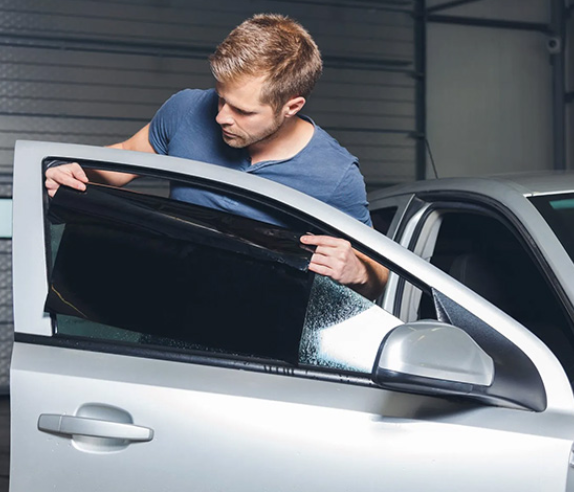
Automotive tinting can look simple in a video, but vehicle glass creates several installation challenges.
The glass must first be cleaned extremely thoroughly. Even a small piece of dust, hair, fiber, or other debris can become visible once the film is installed.
The film then has to be positioned accurately, fitted around edges and seals, and squeegeed to remove the installation solution.
Curved windows create another challenge.
Rear windshields and some side windows require controlled heat shaping so a flat sheet of film conforms smoothly to curved glass.
IWFA’s automotive installation guidance describes professional installation as involving careful cleaning, precise sizing, a slip solution for positioning, squeegee work, and controlled heat where necessary to conform film to window curvature.
For someone installing tint for the first time, this is where creases, fingers, contamination, and uneven edges commonly become noticeable.
A Clean Working Environment Matters
Dust is one of the biggest enemies of a clean tint installation.
A windy driveway, dusty garage, pet hair, pollen, clothing fibers, and dirty window seals can all introduce contamination underneath the film.
Professional installers typically prepare the vehicle and work area specifically to reduce these problems.
Mobile installation can also be performed professionally when the location is suitable. Luxury Glass Tinting’s current mobile service includes an on-site setup, film and shade verification, a final inspection, and aftercare guidance at homes and workplaces in most Los Angeles service areas.
The important factor is not simply whether the installation happens in a shop or at your property—it is whether the environment and process support a clean installation.
Professional Tinting Provides More Precise Fitting
Experienced installers repeatedly work with different types of vehicles and glass.
That experience helps with difficult areas such as curved rear windows, frameless glass, tight seals, quarter windows, defroster-equipped rear glass, and complex door trim.
A high-quality professional installation should have a clean, consistent appearance across the vehicle.
Professional installation is not literally expected to look identical to untreated factory glass under every inspection condition, and minor curing effects can initially be visible.
IWFA’s inspection guidance recognizes that residual installation moisture may temporarily cause haze or distortion while the film dries and bonds fully.
That is different from permanent contamination, creases, peeling, or installation defects.
Professional Tinting Does Not Mean Instant Curing
One misconception is that professionally installed tint is completely cured the moment the vehicle leaves the installer.
It is not.
Automotive window film is generally installed using a water-based application solution. Most of that solution is removed during installation, but some residual moisture can remain temporarily.
The film then needs time to dry and reach its final appearance.
Curing time varies with the film, temperature, humidity, vehicle storage, and other conditions. IWFA says the process may take anywhere from a few days to a couple of weeks depending on circumstances.
During that period, you may be advised to keep roll-down windows closed and avoid pressing or cleaning the film.
Professional installation therefore includes not only applying the film but also explaining what to expect afterward.
DIY Residential Window Tinting Has Different Risks
Home window tinting introduces a different set of concerns from automotive tint.
Residential glass may include single-pane, double-pane, triple-pane, tempered, laminated, factory-tinted, or Low-E glazing.
A film that works well on one type of glass may not be appropriate for another.
Solar-control films absorb different amounts of solar energy. If an unsuitable film is applied to certain glazing systems, it may increase thermal stress.
IWFA specifically advises homeowners to verify whether a particular film is appropriate for Low-E and other specialized windows and notes that manufacturers provide film-to-glass compatibility guidelines.
This is one of the biggest reasons residential DIY tinting deserves more caution than applying a decorative film to a small interior pane.
Automotive Film Should Not Be Used as Home Window Film
Automotive and architectural films are designed for different applications.
Using leftover car tint on household glass is not a good shortcut.
IWFA’s architectural guidance specifically warns that highly absorbing automotive-type films should generally be avoided on architectural glazing because film selection must account for glass type, pane construction, coatings, orientation, climate, and other factors.
Professional residential installers evaluate those factors before recommending a product.
Luxury Glass Tinting currently offers residential films including reflective, dual-reflective, neutral, ceramic, and specialty options selected according to room conditions, privacy needs, glare, heat, and appearance.
Professional Installation Can Include Better Product Guidance
Window film should be chosen according to the problem you want to solve.
A driver focused on heat reduction may benefit from a different film than someone who mainly wants privacy and appearance.
A homeowner dealing with excessive afternoon heat may need a different architectural film than someone trying to create bathroom privacy.
Professional installers can help compare factors such as VLT, heat rejection, UV protection, reflectivity, privacy, glass compatibility, and expected appearance.
IWFA recommends consulting an experienced window-film professional and asking whether your windows are suitable for the film, how long the product should last, and what written warranty applies.
That product-selection guidance is part of what you are paying for with professional installation.
Warranties Can Favor Professional Installation
Warranty coverage varies between manufacturers and products.
Some DIY films come with limited warranties, while professional products may include manufacturer-backed coverage when installed according to specified requirements.
A warranty may address problems such as peeling, bubbling, delamination, adhesive failure, or discoloration, depending on its terms.
Do not assume the word “lifetime” means every type of damage or dissatisfaction is covered.
Ask who provides the warranty, what defects are covered, what documentation must be retained, and whether professional installation is required.
IWFA recommends reviewing written warranty information before purchasing film and notes that professionally supplied films commonly come with manufacturer-backed warranties.
Professional Tinting Can Reduce the Risk of Wasted Material
Film becomes difficult to reuse once it has been contaminated, folded, improperly cut, or creased.
A mistake on a small side window may only waste one section.
A mistake on a large curved rear windshield can waste a much larger piece of material and considerable time.
Professional installers already have experience with film handling, trimming, heat shaping, positioning, and moisture removal.
That does not mean every professional installation is perfect, but experience significantly reduces the learning curve that a first-time DIY installer faces.
Legal Compliance Is Another Consideration for Automotive Tint
Automotive tint laws vary by state and according to the position of the window.
California’s rules should not be reduced to a simple universal statement such as “70% tint is legal everywhere.”
California Vehicle Code §26708 contains different provisions for windshields, front side windows, rear-side windows, and rear windows.
The current statute, amended effective January 1, 2026, includes specific requirements for qualifying clear, colorless, transparent material and the finished glazing system.
A professional installer can help explain suitable film options, although vehicle owners should still verify the current law themselves.
A DIY installer is responsible for making those decisions independently.
Professional Tinting Can Save Time
DIY window tinting can take considerably longer than expected.
The process includes cleaning, measuring, cutting, preparing the film, positioning it, shaping it where required, squeegeeing the solution, trimming edges, correcting problems, and cleaning up.
If a panel goes wrong, the process begins again.
For someone who values their time—or simply wants the vehicle or room finished correctly without learning a new technical skill—the labor cost of professional installation may be easier to justify.
DIY vs. Professional Window Tinting Comparison
| Factor | DIY Tinting | Professional Tinting |
|---|---|---|
| Upfront cost | Usually lower | Usually higher |
| Installation experience | Depends on you | Experienced installer |
| Film selection guidance | Self-researched | Professional guidance |
| Automotive heat shaping | Difficult for beginners | Routine professional process |
| Contamination control | Depends on workspace | Controlled installation process |
| Residential glass compatibility | Must research yourself | Installer can evaluate glazing |
| Warranty | Varies widely | Often manufacturer-backed, depending on product |
| Legal shade guidance | Your responsibility | Installer can explain available options |
| Time required | Can be substantial | Typically more efficient |
| Risk of wasted film | Higher for beginners | Lower with experienced installer |
| Final appearance | Depends heavily on skill | Designed for consistent professional finish |
| Aftercare guidance | Self-researched | Usually provided after installation |
When Does DIY Window Tinting Make Sense?
DIY tinting is not automatically a bad choice.
It may make sense when the project is small, the glass is simple and accessible, appearance does not need to be perfect, and you understand the risks involved.
Decorative film on a straightforward interior glass pane can be much easier than tinting an entire vehicle or installing solar-control film on specialized residential glazing.
DIY can also be useful for someone who genuinely wants to learn the installation process and accepts that the first attempt may not produce professional results.
The key is understanding the complexity of the project before starting.
When Is Professional Window Tinting the Better Choice?
Professional installation becomes much easier to justify when appearance, durability, performance, warranty protection, or glass compatibility matter.
It is particularly worth considering for curved automotive rear windows, premium vehicles, complete-car installations, ceramic or nano-ceramic film, large residential panes, insulated glass, Low-E windows, commercial projects, and specialized privacy or security applications.
These projects involve more than simply adhering film to glass.
They require appropriate product selection and installation methods for the specific application.
Does Professional Tinting Always Last Longer?
Not automatically.
Longevity depends on the film, glass, environment, installation, and maintenance.
Professional installation cannot make a poor-quality film perform like a premium product.
However, combining a reputable film with correct preparation and professional installation generally provides a stronger foundation for long-term performance.
For residential and commercial window film, IWFA says effective life varies according to film type, glass, window construction, orientation, and geographic conditions.
The same principle applies to automotive tint: judge the complete product-and-installation package rather than one marketing claim.
Is Professional Window Tinting Worth the Cost?
For many customers, yes.
What you are purchasing is not simply labor.
Professional installation can include film selection, proper preparation, specialized tools, heat shaping, accurate fitting, glass-compatibility evaluation, legal shade guidance, warranty documentation, final inspection, and aftercare support.
That can be particularly valuable when the film is being installed on an expensive vehicle or specialized architectural glass.
On the other hand, a simple DIY project may be perfectly reasonable if you understand the product, installation method, and potential consequences of a mistake.
The right choice depends on the project and how important the finished result is to you.
Frequently Asked Questions
Is DIY window tinting hard?
It can be. Simple flat panes are easier, while curved automotive glass, rear windows, and large architectural panes require more skill. Cleanliness, fitting, trimming, moisture removal, and film handling all affect the final result.
Is DIY tint cheaper than professional tint?
Usually at the beginning. However, mistakes can require replacement film, extra tools, or professional removal and reinstallation, reducing the initial savings.
Why does DIY window tint bubble?
Bubbles can result from trapped air, contamination, poor squeegee technique, creases, or installation errors. Newly installed tint can also temporarily show moisture patterns during curing, which should not automatically be treated as defects.
Can I install ceramic tint myself?
It is physically possible to purchase and install certain ceramic products yourself, but premium film does not make the installation easier. Incorrect cutting, contamination, heat shaping, or application can still ruin the result.
Is professional tint bubble-free?
A proper professional installation should avoid persistent air bubbles and major defects, but temporary moisture haze or water patterns can occur while the film cures.
Can I tint my home windows myself?
Some simple decorative applications can be DIY projects. Solar-control film on insulated, Low-E, coated, or specialized glazing should be approached more carefully because film-to-glass compatibility matters.
Does professional tint come with a warranty?
Many professional film products include manufacturer-backed warranties, but coverage varies. Ask for the written terms before installation.
Is professional window tinting worth it for a car?
It is especially worthwhile when you want a clean finish, premium ceramic film, consistent shade, professional heat shaping, warranty coverage, and guidance on California requirements.
Is professional residential window tinting worth it?
It can be particularly valuable for large windows, double-pane or Low-E glass, strong solar-control projects, and situations where the wrong film could create performance or compatibility problems.
How long does window tint take to cure?
Curing varies by film and environmental conditions. It can take from several days to longer depending on temperature, humidity, film construction, and storage conditions. Follow the installer’s or manufacturer’s guidance.
DIY vs. Professional Window Tinting: Which Should You Choose?
DIY window tinting offers a lower upfront cost and can work for simple projects when you have the patience, tools, and willingness to learn.
Professional window tinting costs more because you are paying for experience, film-selection guidance, specialized installation techniques, quality control, warranty support, and reduced risk of installation mistakes.
For automotive tinting, professional installation becomes especially valuable on curved windows, complete vehicles, and premium ceramic films.
For residential projects, professional guidance is even more important when double-pane, Low-E, coated, or other specialized glass is involved.
Luxury Glass Tinting provides professional automotive window tinting, residential window tinting, and mobile window tinting in Los Angeles with premium film options, installation guidance, final inspection, and aftercare support.
If the goal is simply to experiment, DIY can be reasonable.
If the goal is a clean, consistent, properly specified installation designed for long-term performance, professional window tinting is usually the stronger investment.