
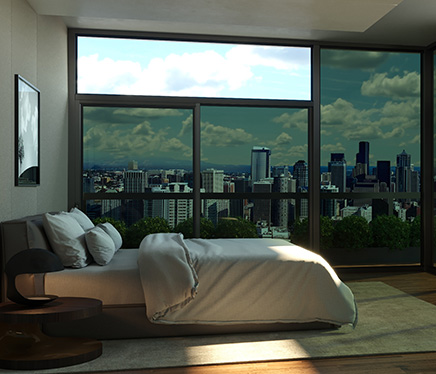
Residential window tinting is a practical way to improve comfort, privacy, glare control, UV protection, and solar performance without replacing otherwise functional windows.
For Los Angeles homeowners, window film can be especially useful in rooms with large areas of glass, strong afternoon sun, street-facing windows, or persistent glare on televisions and computer screens.
Modern residential window tinting also offers far more choice than the dark, mirrored films many people associate with older installations. Today’s options include ceramic, neutral, reflective, dual-reflective, spectrally selective, Low-E, decorative, and specialty films designed for different needs and architectural styles.
The key is selecting the right film for the right glass and the problem you want to solve.
What Is Residential Window Tinting?
Residential window tinting involves applying a thin architectural window film to compatible household glass.
Depending on the product, the film can change how the window interacts with:
- Solar heat
- Visible light
- Ultraviolet radiation
- Glare
- Privacy
- Thermal transfer
- Exterior appearance
Many retrofit films are installed on the interior surface of the glass, although specialized exterior films are also available for applications where outside installation is more appropriate.
The correct location and product depend on the glass, window construction, manufacturer requirements, and desired performance.
How Does Residential Window Film Work?
Sunlight entering your home contains visible light, ultraviolet radiation, and solar energy that contributes to indoor heat.
Window film is engineered to transmit, absorb, or reflect different portions of that energy.
Different technologies produce different results.
For example, a reflective film may prioritize strong solar control and daytime privacy, while a spectrally selective film may reduce solar heat while allowing more visible daylight through.
Ceramic film can provide heat and glare control with a comparatively neutral, low-reflective appearance.
This is why homeowners should compare more than tint darkness when choosing a film.
1. Residential Window Tinting Can Reduce Solar Heat
One of the most common reasons homeowners install window film is excessive solar heat.
Rooms with west- or south-facing windows can become noticeably warmer as sunlight enters through the glass and heats interior surfaces.
Solar-control film can reduce the amount of solar energy entering the room, helping improve comfort near windows and reduce hot spots.
This can be especially useful for:
- Living rooms with large windows
- Home offices
- Kitchens
- Upstairs bedrooms
- Sunrooms
- Sliding glass doors
- Rooms with strong afternoon exposure
Window film does not air-condition a room, and the amount of improvement depends on the exact film, glass, orientation, shading, insulation, and building design.
2. Window Film May Reduce Cooling Demand
Reducing unwanted solar heat can also reduce the amount of cooling needed to maintain comfortable indoor conditions.
That may help lower HVAC demand during warm weather.
However, energy savings should not be presented as a guaranteed percentage.
Actual results depend on variables such as:
- Window area
- Orientation
- Film performance
- Existing glazing
- Climate
- HVAC efficiency
- Building insulation
- Thermostat settings
- Exterior shading
- Household behavior
For Los Angeles homes with significant sun-exposed glazing, solar-control film can be a useful energy-efficiency measure, but the expected impact should be evaluated based on the specific property.
3. Quality Residential Film Can Block UV Radiation
Ultraviolet exposure is another reason homeowners consider window film.
Quality architectural films can block up to approximately 99% of UV radiation, depending on the product.
This can benefit occupants while also helping reduce UV exposure to:
- Hardwood floors
- Carpets
- Furniture
- Upholstery
- Curtains
- Artwork
- Photographs
- Interior finishes
UV radiation is only one contributor to fading. Visible light, solar heat, humidity, dyes, and material composition also play roles.
Residential film can therefore help reduce fading, but it cannot guarantee that furniture or flooring will never fade.
4. Residential Tint Can Reduce Glare
Large windows provide excellent daylight, but too much direct or reflected sunlight can make a room uncomfortable.
Glare can interfere with:
- Television viewing
- Computer monitors
- Tablets
- Home-office work
- Reading
- Everyday visual comfort
Window film can reduce visible-light glare while still allowing natural daylight into the room.
The amount of glare reduction depends partly on the film’s Visible Light Transmission, or VLT.
Lower VLT generally reduces more visible light, but it can also make the room darker. The best film balances glare control with the amount of daylight you want to preserve.
5. Home Window Tint Can Improve Daytime Privacy
Residential tint can provide additional privacy for homes with windows facing sidewalks, neighboring properties, courtyards, or other high-traffic areas.
Reflective and dual-reflective films are commonly used for this purpose.
However, privacy film needs to be understood correctly.
Many reflective films provide their strongest privacy when the exterior is brighter than the interior.
At night, when your lights are on and it is darker outside, people may be able to see into the room more easily.
For bathrooms, bedrooms, entry doors, or other spaces that require more consistent privacy, frosted, decorative, whiteout, blackout, or other specialty films may be more appropriate.
Luxury Glass Tinting currently offers both solar-control and dedicated privacy-film options for residential applications.
6. Residential Window Film Can Help Protect Interiors
Sun exposure can gradually affect floors, furniture, textiles, artwork, and other interior materials.
Because window film can reduce UV exposure, visible-light intensity, and—in some products—solar heat, it can help slow some of the processes that contribute to fading and deterioration.
This can be particularly valuable in homes containing:
- Hardwood flooring
- Fine furniture
- Artwork
- Collectibles
- Designer fabrics
- Rugs
- Photographs
- Retail-style display areas
No film stops all deterioration, but reducing solar exposure can help preserve interiors longer.
7. Window Film Can Improve the Look of a Home
Residential film can also change the appearance of the glass.
Some homeowners want a sleek, reflective exterior appearance. Others want the windows to look almost unchanged.
Modern architectural films allow for both.
You can choose from:
- Reflective finishes
- Dual-reflective films
- Neutral films
- Low-reflective ceramic films
- Light spectrally selective films
- Frosted privacy designs
- Decorative patterns
- Specialty films
This makes it possible to address comfort or privacy without necessarily making the home look heavily tinted.
What Types of Residential Window Tint Are Available?
Different residential films solve different problems.
Reflective Window Film
Reflective film can provide strong solar control and daytime privacy.
It produces a noticeably reflective exterior appearance and can be useful for highly exposed windows.
Dual-Reflective Window Film
Dual-reflective film is designed to provide greater exterior reflectivity while keeping the interior surface less reflective.
This can improve daytime privacy without creating as much mirror-like reflection when looking outside from indoors.
Neutral Window Film
Neutral film provides solar and glare control while keeping the glass appearance relatively understated.
It can be a good choice when homeowners want performance without a strongly mirrored exterior.
Ceramic Window Film
Ceramic film provides solar control using non-metallic technology.
It is often selected for strong heat and glare performance with a refined, relatively low-reflective appearance.
Spectrally Selective Window Film
Spectrally selective film is designed to reject solar energy while allowing relatively high levels of visible light to pass through.
This makes it useful for homeowners who want to preserve daylight and exterior views while addressing heat.
Low-E Window Film
Low-E, or low-emissivity, film is designed to influence thermal transfer through the glazing system.
Some Low-E products can help reduce unwanted solar heat during warmer periods while also improving heat retention during cooler conditions.
Luxury Glass Tinting currently lists reflective, dual-reflective, neutral, ceramic, spectrally selective, Low-E, and specialty options among its residential films.
Will Residential Window Tint Make Your Home Dark?
Not necessarily.
The amount of daylight reduction depends on the film.
A highly reflective or low-VLT film may noticeably darken a room, while a lighter ceramic or spectrally selective product can retain much more natural light.
If maintaining bright interiors is important, ask your installer to compare:
- Visible Light Transmission
- Reflectivity
- Solar heat performance
- Film color
- Exterior appearance
Do not choose residential tint simply by asking for the darkest option.
What Do VLT, SHGC, and TSER Mean?
Several specifications can help you compare residential window films.
VLT — Visible Light Transmission
VLT describes how much visible light passes through the glazing system.
Higher VLT generally means more daylight and a lighter appearance.
SHGC — Solar Heat Gain Coefficient
SHGC indicates how much solar heat passes through a window system.
Lower values generally indicate less solar heat gain.
TSER — Total Solar Energy Rejected
TSER describes the percentage of total solar energy rejected by a glazing system.
These measurements describe different characteristics, so one number should not be used as a substitute for all window-film performance.
Can Residential Window Film Help in Winter?
Some products can.
Standard solar-control films primarily focus on reducing incoming solar heat, which is especially useful in cooling-dominated climates.
Low-E films are designed to address thermal transfer as well and can contribute to year-round window performance.
The best film depends on whether your priority is:
- Summer solar heat
- Winter heat retention
- Year-round efficiency
- Glare
- Privacy
- Daylight
- Appearance
Film selection should reflect the home’s climate and existing glazing.
Can Window Film Be Installed on Double-Pane Windows?
Often yes, but compatibility should be verified first.
Double-pane insulated glass, laminated glass, tempered glass, Low-E glazing, factory-tinted glass, and other window systems can respond differently to absorbed solar energy.
Window-film manufacturers therefore provide compatibility guidelines for particular glass constructions.
IWFA recommends asking the installer whether the proposed film is appropriate for the existing glazing, especially with Low-E windows.
Professional evaluation is particularly important because inappropriate film selection can influence thermal stress in the glass.
Can Residential Tint Be Installed on Low-E Windows?
Sometimes.
Whether film is appropriate depends on factors such as:
- The type of Low-E coating
- Where the coating is located
- Window construction
- Film type
- Desired reduction in heat gain or heat loss
There is no universal yes-or-no answer.
The installer should identify the glazing and recommend a compatible product based on manufacturer guidelines.
Does Residential Window Tint Reinforce Glass?
Ordinary residential solar-control film should not be described as making glass stronger, shatterproof, or impossible to break.
Those are separate performance questions.
Standard solar film is primarily designed for benefits such as:
- Solar control
- UV protection
- Glare reduction
- Privacy
- Appearance
- Energy performance
If your goal is broken-glass retention, forced-entry resistance, or another security application, you should ask specifically about safety and security window film.
These products are thicker and engineered for glass-retention applications.
Even specialized safety/security film should not be described as making ordinary glass completely unbreakable.
Is Safety and Security Film the Same as Residential Tint?
No.
Safety and security film is a specialized architectural-film category.
It can be designed to help keep broken glass fragments together after certain kinds of impact or breakage.
Some higher-security installations also use perimeter attachment systems designed to help retain filmed glass within the frame.
Solar-control film and safety/security film can sometimes be combined in specialized products, but ordinary residential tint should not automatically be assumed to provide those capabilities.
Does Residential Window Tint Increase Home Value?
Window film can improve comfort, privacy, appearance, and energy performance, which may make a home more appealing.
However, it is not responsible to promise that installing tint will automatically increase a property’s market value by a specific amount.
Real estate value depends on many factors, including:
- Location
- Overall property condition
- Window quality
- Buyer preferences
- Energy performance
- Comparable sales
- Broader market conditions
It is better to describe film as a functional home improvement rather than guaranteeing a financial return at resale.
How Long Does Residential Window Film Last?
There is no single lifespan for every product.
According to IWFA, longevity depends on factors including:
- Film type
- Glass type
- Window construction
- Orientation
- Geographic location
Quality residential films are typically accompanied by manufacturer warranty terms, but those terms vary by product.
Ask your installer for the warranty covering the exact film being proposed rather than relying on a generic lifespan claim.
How Is Residential Window Film Installed?
Professional installation typically begins with evaluating the windows and choosing a compatible film.
The glass is then carefully cleaned and prepared.
Film is measured and cut for each pane, applied using an installation solution, positioned precisely, and finished so the edges appear clean and consistent.
The film then needs time to cure.
Immediately after installation, slight haze or moisture patterns can sometimes be visible while residual installation moisture evaporates.
Follow the installer’s aftercare recommendations before cleaning the treated glass.
Luxury Glass Tinting currently describes its residential installation process as measuring and finishing film pane by pane and providing care guidance after installation.
How Should Residential Window Film Be Cleaned?
Once the film has fully cured, it can generally be cleaned using a soft cloth, clean synthetic sponge, or other non-abrasive material and a suitable non-abrasive glass cleaner.
Avoid abrasive pads, scraping tools, or cleaners that could damage the film surface.
IWFA recommends soft cleaning materials and non-abrasive glass-cleaning solutions.
Your installer should tell you how long to wait before the first cleaning.
How Much Does Residential Window Tinting Cost?
Residential window tint pricing varies according to the project.
Important factors include:
- Film type
- Number of panes
- Window dimensions
- Total square footage
- Glass construction
- Window height
- Accessibility
- Existing film removal
- Installation complexity
- Specialty or security-film requirements
A single generic price per square foot may therefore be misleading.
For a meaningful quote, provide the installer with window measurements, photos, and a description of the problem you want to solve.
You may also discover that only the most sun-exposed or privacy-sensitive windows need treatment rather than every window in the house.
How Do You Choose the Right Residential Window Tint?
Start with the problem rather than the film.
For Excessive Heat
Compare solar-control, ceramic, spectrally selective, reflective, and other heat-management films.
For Daytime Privacy
Consider reflective or dual-reflective film.
For Constant Privacy
Consider frosted, decorative, opaque, blackout, or specialty privacy products.
For Maximum Natural Light
Look at higher-VLT ceramic, neutral, or spectrally selective options.
For Year-Round Thermal Performance
Ask whether a compatible Low-E film makes sense for your windows.
For Broken-Glass or Security Concerns
Request a dedicated safety/security film evaluation rather than standard residential solar tint.
Common Residential Window Tinting Mistakes
One of the biggest mistakes is selecting a film based only on darkness.
Other common problems include:
- Choosing automotive film for residential glass
- Ignoring glass compatibility
- Expecting reflective privacy to work equally well at night
- Assuming all tint provides security protection
- Choosing film solely by price
- Expecting guaranteed energy-bill savings
- Installing film on damaged or failed windows instead of fixing the underlying problem
- Using inappropriate DIY products on specialized glazing
A professional installer should explain the trade-offs before film is applied.
Residential Window Tint vs. Curtains and Blinds
Window film does not necessarily replace curtains, shades, or blinds.
They can serve complementary purposes.
Film continuously manages solar energy, UV exposure, glare, or daytime privacy at the glass.
Window coverings can then provide:
- Complete nighttime privacy
- Decorative styling
- Room-darkening
- Additional light control
Many homeowners benefit from using both.
Residential Window Tint vs. Window Replacement
Window film can improve certain aspects of existing glazing at a much lower level of disruption than full window replacement.
It may be a good option when the windows are structurally sound but have problems with:
- Heat
- Glare
- UV exposure
- Daytime privacy
- Solar performance
Film is not a cure for:
- Failed insulated-glass seals
- Broken panes
- Rotten frames
- Significant air leakage
- Structural deterioration
Those conditions may require repair or replacement.
Frequently Asked Questions
What does residential window tinting do?
Residential window film can reduce solar heat, glare, and UV exposure while improving privacy, interior comfort, and the appearance of existing glazing.
Does residential window tint keep a house cooler?
Solar-control film can reduce solar heat gain through glass and may help make sun-exposed rooms more comfortable. Results depend on the film, glass, orientation, and building conditions.
Can home window tint block 99% of UV rays?
Many quality architectural films can block up to approximately 99% of UV radiation. Verify the specification for the exact product selected.
Does residential window tint lower energy bills?
It may reduce cooling or heating demand depending on the film and building, but savings vary. A fixed percentage should not be guaranteed without evaluating the property.
Can window tint give my home privacy?
Yes, particularly during daylight with reflective or dual-reflective products. Privacy may decrease after dark when interior lighting is brighter than exterior lighting.
Will home window tint make my rooms too dark?
Not necessarily. Modern ceramic, neutral, and spectrally selective films can provide solar benefits while preserving relatively high levels of natural light.
Does window film make glass shatterproof?
No. Ordinary solar-control film does not make glass shatterproof. Dedicated safety/security films are designed for glass-retention applications.
Can tint be installed on double-pane windows?
Often yes, provided the film is compatible with the glazing. Manufacturer film-to-glass guidelines should be followed.
Can window tint go on Low-E glass?
Sometimes. Compatibility depends on the Low-E coating, its position within the window system, glass construction, and film.
Is professional installation worth it?
For solar-control, Low-E, large-pane, specialized glazing, or safety/security applications, professional evaluation and installation can reduce the risks associated with incorrect product selection and poor application.
Professional Residential Window Tinting in Los Angeles
Residential window tinting can be an effective way to improve a home without covering every window with heavy treatments or replacing otherwise functional glazing.
The right film can provide solar heat control, UV protection, glare reduction, daytime privacy, interior protection, and improved comfort while preserving natural light and views.
Luxury Glass Tinting currently provides residential window tinting in Los Angeles with reflective, dual-reflective, neutral, ceramic, spectrally selective, Low-E, privacy, and specialty-film options. Its current residential service is designed around the room’s sun exposure, privacy needs, glare, glass, and desired appearance rather than treating every window the same.
The best residential window tint is therefore not simply the darkest or most expensive film. It is the film that is compatible with your glass and matched to the exact comfort, privacy, daylight, appearance, or energy-performance problem you want to solve.