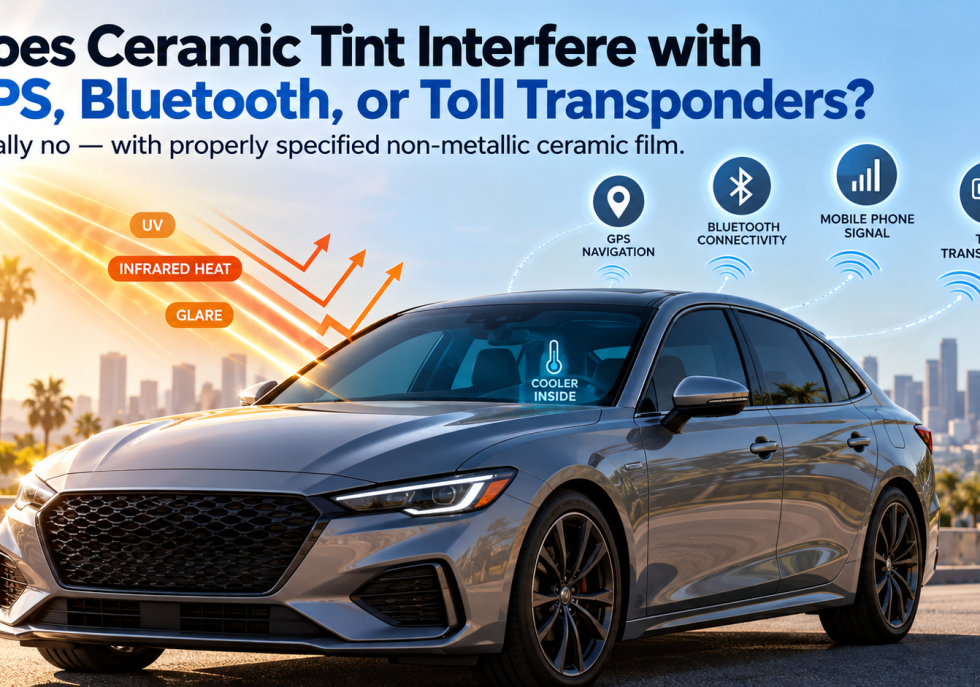
Modern vehicles depend on wireless technology for everything from turn-by-turn navigation to hands-free calls and automatic toll payments. Before tinting your car, it is reasonable to ask: does ceramic tint interfere with GPS, Bluetooth, or toll transponders?
In most cases, no. Properly specified non-metallic ceramic window film is designed to maintain wireless connectivity. It can reduce solar heat and glare without the conductive metal layer associated with some older reflective films. However, your vehicle’s original glass, antenna locations, and toll-tag mounting position still matter.
Why Can Window Tint Affect Electronic Signals?
GPS, mobile phones, Bluetooth and electronic toll systems all use radio-frequency (RF) signals. Those signals must reach an antenna, receiver or reader to work reliably. Connection strength depends on factors including frequency, distance, obstacles, and the materials between devices.
Some traditional window films contain a thin metallic layer to reflect solar energy. Conductive materials can also reflect or attenuate radio waves. Depending on the film’s design and the vehicle’s antenna placement, metallic tint signal blocking may weaken reception.
Film composition is more important than shade: a dark, non-metallic film may transmit radio signals more readily than a comparatively light metallized one.
How Non-Metallic Ceramic Tint Works
Ceramic automotive tint incorporates microscopic ceramic materials into a multilayer film. Instead of relying on a reflective metal coating, the ceramic construction manages solar energy, including infrared radiation, while maintaining a comparatively neutral appearance.
Because a genuinely non-metallic tint has no continuous conductive metal layer, it is much less likely to attenuate signals passing through the glass. For example, 3M describes its Ceramic IR Series as metal-free and compatible with GPS, satellite radio, and mobile devices, including 5G. LLumar’s IRX ceramic film also highlights easy electronic connectivity.
There is an important distinction between managing infrared sunlight and blocking radio-frequency communication. Both involve electromagnetic energy, but they operate at different wavelengths. Effective infrared rejection does not mean a film must disrupt navigation or wireless devices.
Always ask for the film’s exact specifications.
Does Ceramic Tint Block GPS Navigation?
A GPS receiver calculates its position using weak signals transmitted by navigation satellites. Your smartphone, dashboard navigation system or dashcam may have its own antenna or use an antenna integrated elsewhere in the vehicle.
A verified metal-free ceramic film should not introduce the metallic shielding associated with some reflective films. GPS signal window film concerns matter more when the windscreen has a factory-applied metallic or heat-reflective coating, or when an antenna has an obstructed view of the sky.
For instance, navigation may drop out in tunnels, multi-story car parks and streets surrounded by tall buildings even without tint. If your GPS has deteriorated, compare reception outdoors in the same location, check the device’s antenna settings and identify any special factory glazing before blaming the ceramic film.
Will Ceramic Tint Affect Bluetooth and Mobile Reception?
Bluetooth connections inside the car
Bluetooth commonly links your phone with the vehicle’s infotainment system over a short distance. When both devices are inside the cabin, a tinted window is not normally between them. For this reason, Bluetooth signal through tint is rarely the explanation for intermittent audio, pairing problems or dropped calls.
Check software, pairing settings, device compatibility and nearby interference first. If you use a Bluetooth accessory outside the car, the surrounding glass and bodywork matter more, but non-metallic film remains the lower-risk choice.
Mobile phone signals, 4G and 5G
Drivers also ask, does tint block cell signal? A correctly specified ceramic film is designed to avoid that problem. Radio signals can still be affected by mobile-network coverage, vehicle construction, the position of the phone, and the use of metalized factory glass.
In-car Wi-Fi hotspots
With tint and Wi-Fi hotspot performance, separate the two wireless links. Your phone or laptop connects to the car’s Wi-Fi network, while the car may obtain internet access through a cellular modem. Ceramic tint should not materially shield either connection, although weak cellular coverage can still slow the hotspot.
Can Ceramic Tint Interfere with Toll Transponders?
Toll transponders communicate with roadside equipment using radio technology. A metal-free ceramic film is generally compatible, but correct placement is essential.
FasTrak: relevant to Southern California
Los Angeles-area drivers are more likely to use FasTrak than E-ZPass. The 405 Express Lanes guidance gives distinct mounting instructions for sticker and switchable transponders. It also describes an exterior tag option for vehicles with metalized windscreens.
Follow the instructions for your particular account and tag. Do not assume that moving a sticker to an arbitrary corner will solve a missed read.
E-ZPass and special windscreens
E-ZPass window tint questions arise particularly when traveling in states that use E-ZPass. The Ohio Turnpike’s E-ZPass guidance warns that metallic tinting or certain windscreen heating features can prevent proper reading. An alternative approved mounting position may be needed.
E-ZPass and FasTrak are different toll systems: do not assume a tag or account issued for one works in the other’s network. Always check the relevant operator’s acceptance and mounting rules before traveling.
Practical tip: Tell your tint installer where your toll tag sits before work begins. Avoid attaching or removing a tag directly on newly installed film until the installer confirms it is safe.
What About Radio, Garage Openers and Keyless Entry?
AM/FM and satellite radio
Antenna position matters. Some cars use a roof-mounted aerial, while others integrate antennas into rear or side glass. A metallic film applied over antenna-bearing glass could potentially affect reception. Non-metallic ceramic film avoids the additional metal layer, making ceramic tint radio reception problems less likely.
Signal dropouts may instead result from tunnels, terrain, faulty aerial connections, or damaged wiring. Establish when the fault occurs before replacing film.
Garage door and gate remotes
Garage door opener tint interference is generally not expected from metal-free ceramic film. If your remote operates inconsistently, try a fresh battery, check the opener’s programming, and test from a safe, consistent distance. Vehicle bodywork and factory glazing may affect range independently of tint.
Keyless entry and phone-as-key
Keyless entry systems vary. Some use low-frequency proximity signals and other radio links; phone-as-key features may rely on Bluetooth or additional technologies. Non-metallic film shouldn’t create the shielding associated with conductive tint, but vehicle antenna design and device position can still affect performance.
If a particular door handle or phone-key feature becomes unreliable, consult the vehicle manual and test the system in controlled conditions rather than assuming all wireless faults have the same cause.
Ceramic vs Metallic Tint: Which Is Better for Connectivity?
For drivers who prioritize window tint and electronics, film construction is the key decision:
- Ceramic tint: Uses a non-metallic ceramic formulation; designed for heat rejection with minimal RF interference risk.
- Metallized tint: Contains a metal component that can attenuate certain signals, depending on its structure and placement.
- Dyed tint: Generally has no metal layer and is usually signal-friendly, but heat-rejection performance depends on the particular product.
- Hybrid tint: May combine technologies, potentially including metal; confirm the exact composition before buying.
Visible light transmission (VLT) describes how much visible light passes through the glass. It is not a direct measure of GPS, Bluetooth, or toll-tag compatibility. Likewise, a high infrared-rejection figure says nothing about RF transparency on its own.
How to Check Your Vehicle Before and After Tinting
If seamless connectivity is important, use this short checklist:
- Identify the glass. Look in the owner’s manual for heat-reflective, metallic-coated, or special toll-transponder mounting zones.
- Confirm the film. Ask for the manufacturer’s name, product series, and confirmation that the selected film is non-metalized.
- Locate equipment. Tell the installer about dashcams, GPS receivers, glass-integrated aerials and electronic toll tags.
- Record a baseline. Before installation, test navigation, mobile reception, keyless entry and the garage remote in repeatable locations.
- Test again fairly. Compare the same equipment and locations after installation. Signal bars alone are imprecise; actual navigation fixes, call stability, and documented toll reads are more useful.
- Investigate one system at a time. If a problem appears, check device settings, existing glass coatings and mounting positions before deciding the tint is responsible.
Do not place film over cameras or sensors without checking the vehicle manufacturer’s requirements. A film’s RF compatibility does not guarantee that it is suitable for windscreen-mounted driver-assistance cameras or other optical equipment.
Choosing Ceramic Tint in Los Angeles
For everyday commuting around Los Angeles and Culver City, heat management and reliable navigation are both important. Luxury Glass Tinting’s automotive film range includes LLumar IRX and CTX ceramic options, while its ceramic window tinting service focuses on heat reduction, comfort, and connectivity.
Ask which film is being installed on each window, whether your vehicle has signal-sensitive glazing, and where to mount your FasTrak device. Tint shade and windscreen coverage must also meet applicable California rules; signal compatibility does not override legal visibility requirements.
Frequently Asked Questions
1. Does ceramic tint interfere with GPS navigation?
Genuine non-metallic ceramic film is designed not to obstruct GPS radio signals. If navigation is unreliable, check antenna location, urban obstructions, and factory metallized glass before attributing the issue to tint.
2. Will Bluetooth stop working after ceramic tinting?
It should not. Your phone and in-car audio system usually communicate within the cabin, and the ceramic film is not between them. Pairing problems are more often related to settings or device compatibility.
3. Can ceramic tint cause dropped calls or weak 5G?
Non-metalized films are designed to maintain mobile connectivity, including modern cellular networks. Coverage, vehicle construction, or a faulty device can still cause dropped calls; no tint can improve a weak network signal.
4. Does ceramic tint affect FasTrak transponders?
Ceramic film is generally compatible with FasTrak’s radio-based tags. However, an existing metallic windscreen coating or incorrect tag placement can prevent reliable detection. Follow your FasTrak operator’s mounting instructions.
5. Will E-ZPass work through tinted glass?
Usually, yes, if the tint is non-metallic and the tag is mounted correctly. Metallic-coated or specially heated windscreens may need an approved alternative position or an exterior transponder, depending on the issuing agency.
6. Does darker ceramic tint block more electronic signals?
Not simply because it is darker. VLT measures visible light, not radio-frequency transmission. The film’s actual material construction matters more than its darkness.
7. Can window tint interfere with a garage door opener?
Metalized films and certain factory glazing may affect some radio links. Non-metallic ceramic tint is unlikely to be the cause. Check the remote battery, receiver, and normal operating range first.
8. Does ceramic tint affect keyless entry or an in-car hotspot?
It should not introduce significant RF shielding. Keyless access depends on antenna placement and vehicle design, while hotspot speed also depends on mobile data coverage. Test the affected system separately if problems occur.
Final Verdict: Choose Film Construction, Not Just Shade
Ceramic tint signal interference is generally not a concern with a verified non-metallic product. Properly specified ceramic film lets drivers enjoy heat and glare control without the added signal-blocking risk associated with certain metalized films. However, factory glass coatings, antenna locations, and toll-tag placement still deserve attention.
For help selecting a signal-friendly film, explore Luxury Glass Tinting’s automotive window tinting options or contact the Los Angeles team to discuss your vehicle and electronic accessories before installation.