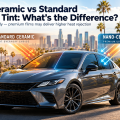
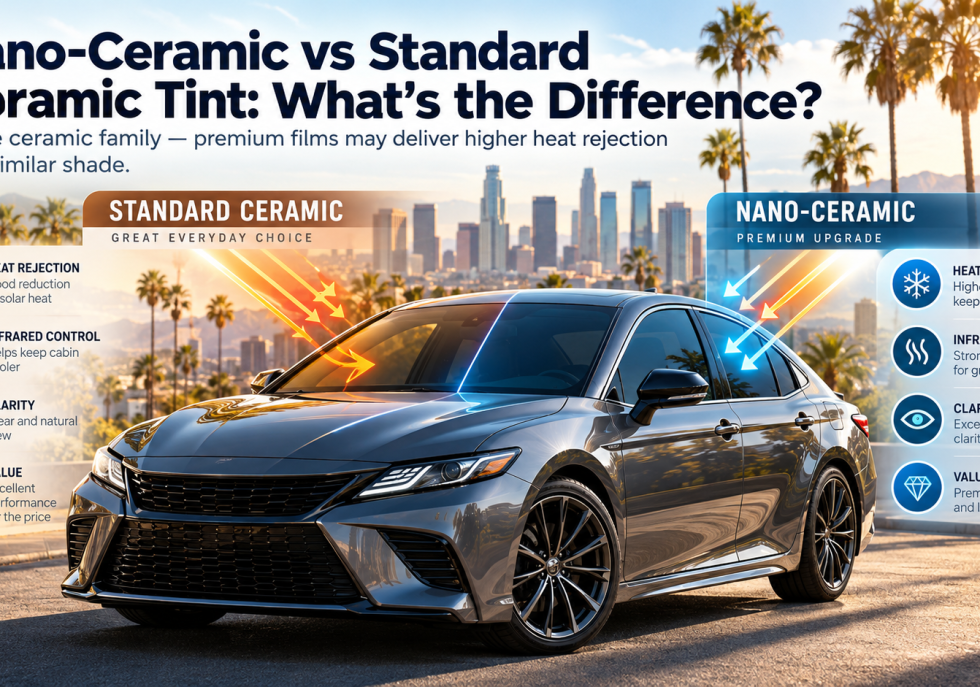
Choosing window tint used to mean comparing shades. Today, drivers are offered standard ceramic, nano-ceramic, multi-layer, and even graphene-branded films, often with impressive claims about infrared rejection. So what is the difference between nano-ceramic and ceramic tint, and is the premium upgrade worth it?
The short answer: nano-ceramic is a form of ceramic window film, not an entirely separate category. Many ordinary ceramic films already contain microscopic ceramic particles. Premium products may use more sophisticated particle formulations or layer designs to improve heat rejection at a similar shade, but the name alone proves nothing. Compare published performance figures and installation quality before paying extra.
What Is Standard Ceramic Window Tint?
Ceramic tint is an automotive window film that incorporates ceramic materials to help manage solar energy. Unlike a basic dyed film, which primarily changes the appearance of glass and reduces incoming light, a well-engineered ceramic film can reject substantial infrared energy without necessarily looking very dark.
A typical film contains protective coatings, polyester, adhesive, and heat-managing layers; construction varies by manufacturer.
Standard ceramic film can offer UV protection, glare control, and color stability. Many versions are non-metalized and compatible with vehicle electronics.
Importantly, standard does not mean low quality. A reputable ceramic film can be an excellent choice for an everyday vehicle when its performance matches the driver’s needs.
What Is Nano-Ceramic Window Tint?
In materials science, nano refers to dimensions measured in nanometres. In window film, manufacturers use nano ceramic technology to describe extremely small ceramic particles or specialized structures that influence how the film absorbs, reflects, or transmits solar radiation.
Those particles can target infrared wavelengths while maintaining visible-light transmission.
However, no universal consumer grading system automatically makes a film “nano-ceramic” at a certain price or performance level. Some manufacturers describe several ceramic tiers as nano-ceramic. Therefore, nano-ceramic vs standard ceramic tint is often a comparison of product tiers rather than two fundamentally different materials.
Ask for the named film series and its specification sheet.
Nano-Ceramic vs Ceramic Tint: Five Differences That Matter
1. Total solar heat rejection
Heat control is usually the strongest reason to choose premium ceramic tint. Advanced formulations may reject more total solar energy than a mid-range film while maintaining similar visible light transmission.
However, tint cannot stop all cabin heating; sunlight also reaches other surfaces.
The most useful comparison figure is Total Solar Energy Rejection (TSER), which accounts for the overall solar energy kept from entering through the tested glazing. Compare TSER values at similar shades and under the same test conditions.
2. Infrared control
Infrared radiation contributes substantially to the warmth people experience through glass. Some high-performance ceramic film uses carefully selected particle chemistry or additional functional layers for better infrared control.
Beware of headline figures such as “97% infrared rejection” without a measurement range. A manufacturer might report rejection at one wavelength rather than across the full solar infrared spectrum.
The International Window Film Association’s automotive guide recommends considering infrared figures alongside TSER. A higher infrared percentage does not mean the same percentage of all solar heat is excluded.
3. Optical clarity and appearance
A well-made film should maintain a clear outward view and a consistent color. Premium constructions may help reduce undesirable reflections or haze while delivering higher heat rejection, but neither benefit is guaranteed by the word nano.
Inspect samples in sunlight and shade. Darkness is not proof of advanced performance.
4. Construction and durability
Both standard and premium films may use several layers, protective topcoats and pressure-sensitive adhesives. Long-term results depend on the overall construction, not just the ceramic particles.
Check warranty terms for bubbling, peeling, and color change. Professional installation matters too.
5. Cost and value
Premium nano-ceramic films normally cost more because of their position within a manufacturer’s range, material design, and sometimes warranty or dealer program. But an expensive product is not automatically better for every driver.
Weigh extra TSER and warranty features against the price.
Single-Layer vs Multi-Layer Tint: Does More Mean Better?
The phrase single-layer vs multi-layer tint can be misleading. Most modern automotive films contain multiple physical layers, even when sellers call their heat-rejection technology “single-layer”. They may simply be referring to one functional ceramic coating rather than the complete film structure.
A multi-layer ceramic film can combine materials or optical layers to influence different wavelengths of solar energy. This design can be sophisticated: 3M’s Crystalline range describes a construction incorporating more than 200 layers and ceramic nanotechnology.
Still, counting layers does not establish quality. Particle dispersion, adhesives, and tested performance also matter.
Understanding the Numbers on a Ceramic Tint Specification Sheet
To compare ceramic tint tiers explained by actual performance, focus on these measurements:
- VLT (Visible Light Transmission): the percentage of visible light passing through the tested glass and film. Higher VLT means a lighter appearance.
- TSER (Total Solar Energy Rejection): the percentage of total solar energy rejected by the glazing. Higher values generally indicate better overall heat control.
- IRER (Infrared Energy Rejection): a broader measure of infrared performance which accounts for absorbed energy that can be released back into the vehicle.
- SIRR (Selective Infrared Rejection): the proportion of measured infrared radiation not transmitted directly through the glass. It differs from IRER.
- UV rejection: the proportion of ultraviolet radiation reduced within the manufacturer’s stated wavelength range.
Do not compare a film’s VLT measured alone with another product’s VLT measured on glass, or a narrow-band infrared headline with broad-spectrum IRER. Compare figures measured using the same glazing and method.
Real Product Comparison: Pinnacle vs Stratos
Luxury Glass Tinting’s automotive window tinting page lists FormulaOne by LLumar Pinnacle as a ceramic option and Stratos as a premium nano-ceramic option. Crucially, LLumar describes both families as using nano-ceramic technology. Stratos stands out for its more advanced Hybrid-Matrix construction and higher performance in the range.
The manufacturer’s FormulaOne performance sheet provides a useful near-like-for-like comparison:
- Pinnacle 35: 38% VLT, 55% TSER and 61% IRER.
- Stratos 35: 39% VLT, 58% TSER and 67% IRER.
Both list more than 99% UV protection. At these closely matched shades, Stratos delivers three percentage points more TSER and six points more IRER in the published test. Those differences are meaningful but should not be described as an additional 58% reduction in cabin temperature.
These figures were calculated using nominal 6 mm clear glass under the manufacturer’s stated methodology. Real results vary with vehicle glazing, sun angle and conditions. Confirm the available shades and current product details before booking.
What About Graphene Ceramic Tint?
Graphene ceramic tint is another term appearing in the premium film market. Graphene refers to a carbon-based material, not a special grade of ceramic. A manufacturer might incorporate a graphene-related component into a hybrid film or simply use the term in its product branding.
The presence of graphene does not automatically demonstrate better heat rejection, optical clarity, or lifespan. There is no reason to assume a graphene-labeled product beats established ceramic films without comparable test data.
Also, automotive window tint should not be confused with a graphene or ceramic paint coating. A paint coating is applied to exterior bodywork; window film is a separate product designed for glazing. Compare each according to its intended purpose.
Which Ceramic Tint Tier Should You Choose?
Choose standard ceramic tint if you want noticeably better comfort than basic dyed film, good UV protection, reduced glare, and a sensible balance between performance and price. It often suits commuters, family vehicles, and drivers whose cars are regularly parked under cover.
Consider a premium ceramic tint upgrade if you frequently drive in exposed sunlight, have a vehicle with extensive glass or value the highest available heat performance at your preferred legal shade. Drivers who spend long periods on Los Angeles roads may appreciate even incremental gains in comfort.
Either way, check your vehicle’s factory glazing. Dark privacy glass does not necessarily provide the same solar performance as an added ceramic film, and existing glass affects the final light transmission.
California also restricts aftermarket tint on windscreens and front side windows, with limited exceptions for qualifying clear UV-protective materials. A particular ceramic film’s shade isn’t automatically legal just because it is sold locally. Confirm compliance for each window before installation.
Professional Installation and Aftercare Matter
The best ceramic tint technology can disappoint if fitted poorly. Contaminants, creases, misaligned edges and improper heat shaping affect appearance and may shorten service life. Ask your installer about glass preparation, film identification, warranty paperwork and curing instructions.
After fitting, keep side windows raised for the period your installer specifies. Avoid cleaning the interior film until permitted, then use a soft microfibre cloth and an approved cleaner. Temporary haze or small moisture pockets may clear as the installation dries; have a professional inspect persistent lifting or creases.
Luxury Glass Tinting offers ceramic window tinting in Los Angeles and can explain the available film options for your car, preferred appearance, and budget.
Frequently Asked Questions
1. Is nano-ceramic tint better than regular ceramic tint?
Sometimes, but not by definition. Premium nano-ceramic products can improve heat rejection and comfort, while many standard ceramic films already use nano-sized ceramic particles. Compare VLT, TSER, and IRER for specific products at similar shades.
2. Does nano-ceramic tint block more heat?
It may. For example, published FormulaOne data gives Stratos 35 a higher TSER than Pinnacle 35 at a closely matched VLT. Performance varies by brand, shade, and test method; the word nano alone is not a guarantee.
3. Is multi-layer ceramic film always superior?
No. More layers can enable advanced optical design, but performance also depends on materials, manufacturing, and adhesives. Request test results rather than treating layer count as a quality score.
4. Does ceramic tint have to be dark to work?
No. Some lighter ceramic films reject substantial solar energy while allowing more visible light through. Choose your shade using comfort needs, visibility, and California’s applicable tint requirements.
5. Is graphene ceramic tint worth the extra money?
Only when its documented benefits justify the price. Graphene-related branding does not independently prove superior TSER, durability or clarity. Compare the actual film and warranty with proven ceramic alternatives.
6. Will premium nano-ceramic film affect GPS or mobile reception?
A verified non-metalized ceramic film is generally designed to preserve wireless connectivity. Reception may still depend on factory metallic glazing and antenna location. Check the chosen film’s specification.
7. Does nano-ceramic tint last longer than standard ceramic?
Not necessarily. Both can last a long time when professionally installed. Lifespan depends on materials, exposure, cleaning, and installation quality. Read the exact manufacturer’s limited warranty rather than assuming every premium film lasts forever.
8. Is the premium ceramic upgrade worth it in Los Angeles?
For frequent drivers exposed to strong sunlight, improved TSER at a comparable shade may be worthwhile. For shorter journeys or covered parking, a good standard ceramic film might already deliver the comfort you need.
Final Verdict: Compare Performance, Not Marketing Labels
The key lesson in nano ceramic vs ceramic tint is that both can share the same underlying technology. Premium films may offer real benefits, but those benefits should appear in trustworthy specifications, not just a more technical name.
When choosing advanced ceramic window film, compare TSER, IRER, VLT, warranties, and installation standards. To discuss Pinnacle, Stratos, and suitable tint options for your vehicle, contact Luxury Glass Tinting for film-specific advice and a quote.