When you decide to tint your vehicle, one of the first questions is where the installation should happen.
Should you take your car to a dedicated tint shop, or should a professional installer come to your home or workplace?
For Los Angeles drivers, both options can work extremely well.
Mobile window tinting prioritizes convenience by bringing the installer to you. A traditional tint shop provides a dedicated installation environment with predictable workspace conditions and immediate access to shop equipment.
Neither option is automatically better.
The quality of the finished tint depends much more on the film, installer, preparation, working conditions, installation technique, final inspection, and aftercare than on whether the car is parked at a tint shop or at your home.
Luxury Glass Tinting currently provides professional mobile window tinting in Los Angeles along with automotive tint services using premium film options.
This guide compares mobile window tinting with traditional tint-shop installation so you can decide which approach best fits your vehicle, schedule, location, and expectations.
Quick Comparison: Mobile Window Tinting vs. Tint Shop
| Factor | Mobile Tinting | Tint Shop |
|---|---|---|
| Convenience | Excellent | Requires travel |
| Waiting/transport | Minimal | May require waiting or arranging transportation |
| Work environment | Depends on location | Usually more predictable |
| Weather exposure | Can matter | Usually protected |
| Dust/wind control | Location-dependent | Generally easier to control |
| Film selection | Provider-dependent | Provider-dependent |
| Installation quality | Can be excellent | Can be excellent |
| Complex work | Depends on mobile setup | Often easier in dedicated facility |
| Scheduling | Highly convenient | Appointment-based |
| Price | Provider/project-dependent | Provider/project-dependent |
| Final inspection | Should be included | Should be included |
| Aftercare | Should be included | Should be included |
The important takeaway is simple:
Mobile does not automatically mean lower quality, and a shop does not automatically guarantee better work.
Evaluate the installer and the conditions of the specific appointment.
What Is Mobile Window Tinting?
Mobile window tinting is a professional automotive-film service performed at an approved location rather than requiring the vehicle to travel to a tint facility.
Common appointment locations include:
- Your home
- Your workplace
- A private garage
- A covered parking area
- Another suitable location arranged with the installer
The installer arrives with the equipment and film required for the scheduled vehicle.
Luxury Glass Tinting’s current mobile service includes appointment confirmation, vehicle and location details, film and shade selection, professional on-site setup, installation, final inspection, and curing/aftercare guidance.
The main advantage is that the service fits around your schedule rather than requiring your day to revolve around a trip to the tint shop.
What Happens at a Traditional Tint Shop?
With traditional shop installation, you bring the vehicle to the tint provider’s facility.
The shop typically has a dedicated work area equipped for:
- Glass cleaning
- Film preparation
- Cutting
- Heat shaping
- Installation
- Lighting
- Inspection
- Film storage
A dedicated shop can make environmental conditions more predictable because the installer has greater control over wind, dust, rain, temperature, workspace access, and equipment placement.
For customers who do not mind dropping off the car or waiting nearby, this can be a very straightforward option.
1. Convenience: Mobile Tinting Has the Clear Advantage
Convenience is the strongest argument for mobile window tinting.
Instead of:
- Driving across Los Angeles
- Sitting in traffic
- Dropping off your car
- Finding transportation
- Waiting at the shop
- Returning later to collect the vehicle
the installer comes to you.
That can be particularly useful for:
- Busy professionals
- Remote workers
- Parents
- Business owners
- Customers with several vehicles
- People who prefer home appointments
- Customers who cannot easily leave work during business hours
Luxury Glass Tinting currently offers home and workplace mobile appointments in most Los Angeles service areas.
For many customers, this is enough to make mobile installation the better choice.
2. Installation Environment: Tint Shops Usually Have More Predictable Conditions
This is where the original mobile-vs-shop comparison needs an important correction.
A mobile installer does not automatically have more control over the environment than a professional tint shop.
Usually, the opposite is true.
A dedicated shop provides a workspace specifically designed or adapted for automotive work.
That can make it easier to control:
- Wind
- Dust
- Pollen
- Rain
- Direct sunlight
- Workspace access
- Lighting
- Equipment placement
A mobile installation can still produce excellent results, but the location needs to be suitable.
A clean private garage, for example, can provide very good working conditions.
An exposed driveway on an unusually windy or dusty day may be more challenging.
The question should therefore be:
“Is this location suitable for a professional tint installation?”
rather than simply asking whether mobile or shop tinting is better.
Why a Clean Environment Matters
Automotive tint is installed directly against glass.
Before application, the installer needs to clean the window thoroughly and minimize contamination.
Dust, hair, fibers, pollen, and debris can become trapped between the film and glass.
That is why preparation is critical.
The International Window Film Association describes professional automotive installation as involving thorough cleaning, precise film sizing, application using a water-based installation solution, squeegee work, and heat shaping where required.
A quality mobile installer needs to follow the same fundamentals as a shop-based installer.
3. Quality of Work: The Installer Matters More Than the Address
Mobile installation is not inherently inferior.
Shop installation is not inherently superior.
The finished quality depends heavily on:
- Installer experience
- Film quality
- Glass preparation
- Workspace cleanliness
- Proper cutting
- Heat-shaping technique
- Edge finishing
- Contamination control
- Final inspection
A highly experienced mobile installer working in appropriate conditions can produce a premium result.
A poorly trained installer inside a building can still produce bad tint.
When evaluating either service, look at:
- Recent completed work
- Customer reviews
- Film manufacturer
- Warranty
- Installer experience
- Installation process
- Aftercare support
Do not make the decision based solely on whether the company has a storefront.
4. Film Selection: Mobile Does Not Automatically Mean Fewer Choices
Another assumption worth correcting is that mobile tinting necessarily offers a very limited film selection.
That depends entirely on the provider.
A mobile appointment is normally planned in advance.
This gives the installer an opportunity to confirm:
- Vehicle
- Window configuration
- Film series
- Tint shade
- Coverage
- Customer goals
before arriving.
Luxury Glass Tinting’s current mobile process specifically includes film and shade confirmation before installation begins.
Its wider automotive lineup includes premium LLumar:
- Dyed film
- Ceramic film
- Nano-ceramic film
- Virtually clear film
If you are interested in a particular film series, confirm availability when booking rather than assuming every product will automatically be carried in the mobile vehicle.
5. Tint Shops May Make Last-Minute Product Changes Easier
A traditional shop can have an advantage when you arrive unsure about what you want.
Because inventory and displays may already be on-site, it may be easier to compare several available products or change your selection immediately.
For example, you might arrive planning to install dyed tint but decide you prefer ceramic after comparing performance and appearance.
With mobile service, it is better to discuss these decisions before the appointment so the installer can arrive with the appropriate material.
That does not make mobile selection worse.
It simply rewards better preparation.
6. Both Options Should Include Film and Shade Guidance
A professional installer should not simply ask:
“How dark do you want it?”
There is much more to choosing automotive tint.
Film selection should account for:
- Heat rejection
- UV protection
- Glare
- Privacy
- Nighttime visibility
- Vehicle appearance
- Existing factory privacy glass
- California regulations
- Budget
Premium ceramic technology can also provide strong solar performance without requiring extremely dark glass.
A knowledgeable installer should explain these trade-offs whether the consultation takes place at a shop or beside your vehicle at home.
7. Time Efficiency: Mobile Saves Travel Time, Not Necessarily Installation Time
Mobile tinting can save significant customer time because it eliminates transportation to and from the shop.
But that does not mean the actual tinting process suddenly becomes much faster.
Professional installation still requires:
- Setup
- Glass preparation
- Film sizing
- Heat shaping where necessary
- Application
- Squeegee work
- Edge finishing
- Inspection
The complexity also varies by vehicle.
A simple vehicle with fewer windows is different from a car with complex rear glass, quarter windows, frameless doors, or existing film requiring removal.
Luxury Glass Tinting currently states that many mobile jobs can be completed the same day, but timing depends on the vehicle and number of windows.
Avoid choosing an installer primarily because they promise an unusually fast job.
Precision matters more than speed.
8. Mobile Tinting Can Let You Continue With Your Day
The real time-saving benefit is customer time.
During a home appointment, you may be able to:
- Work remotely
- Handle household tasks
- Spend time with your family
- Avoid arranging a ride
During a workplace appointment, you may be able to continue your normal workday while the service is completed.
That is very different from claiming the tint itself takes less time to install.
For many Los Angeles customers, avoiding traffic alone can make mobile service highly attractive.
9. Weather Can Affect Mobile Installation
Weather is one factor that mobile customers need to consider.
Conditions such as:
- Strong wind
- Dust
- Rain
- Extreme outdoor exposure
- Inadequate shelter
can make an exposed installation location less suitable.
A private or covered garage can minimize many of these concerns.
A professional mobile provider should assess whether the planned workspace is appropriate rather than forcing an installation under poor conditions.
A dedicated tint shop has a natural advantage here because the working environment is generally protected from weather.
10. You Need Enough Space for Mobile Tinting
Mobile service requires more than a legal parking spot.
The installer needs enough room to work safely around the vehicle.
Luxury Glass Tinting currently asks mobile customers for a safe parking area with sufficient room to access both sides of the vehicle.
For gated buildings, apartment garages, offices, or secured properties, access should be arranged before the appointment.
Consider:
- Can doors open fully enough for the installer?
- Can the installer move around both sides?
- Is the area sufficiently clean?
- Is access permitted?
- Is the garage height suitable?
- Will security allow the service provider inside?
Solving these questions before the appointment helps the installation go smoothly.
11. Tint Shops Can Be Better for Certain Complex Jobs
A dedicated shop may be the more practical choice for certain projects.
Examples can include:
- Extensive old-tint removal
- Severe adhesive cleanup
- Very complex vehicles
- Projects requiring extended workspace access
- Situations where the customer’s location is unsuitable
- Poor weather conditions
- Work requiring equipment better kept at the shop
This does not mean these jobs can never be performed through mobile service.
It means the installer should determine which environment is appropriate for the specific project.
The best companies should recommend the installation method that supports the best result—not simply force every vehicle into the same workflow.
12. Price: Do Not Assume Mobile Is Always More Expensive
There is no universal rule that mobile tinting costs more.
There is also no guarantee that a shop is cheaper.
Pricing can depend on:
- Vehicle
- Number of windows
- Film technology
- Film series
- Tint removal
- Complexity
- Coverage
- Location
- Installation provider
Ceramic and nano-ceramic film will generally cost more than basic dyed film because they are different products with different performance characteristics.
When comparing quotes, make sure you are comparing the same service.
A low quote for entry-level dyed film is not equivalent to a quote for premium nano-ceramic film.
What Should a Tint Quote Include?
Before comparing prices, determine:
- Film manufacturer
- Exact film series
- Film type
- Windows included
- Old-tint removal, if necessary
- Warranty
- Mobile or shop service
- Any additional fees
- Aftercare support
The cheapest total is not automatically the best value.
Likewise, a higher price does not guarantee better workmanship.
13. Mobile and Shop Tinting Should Use the Same Installation Fundamentals
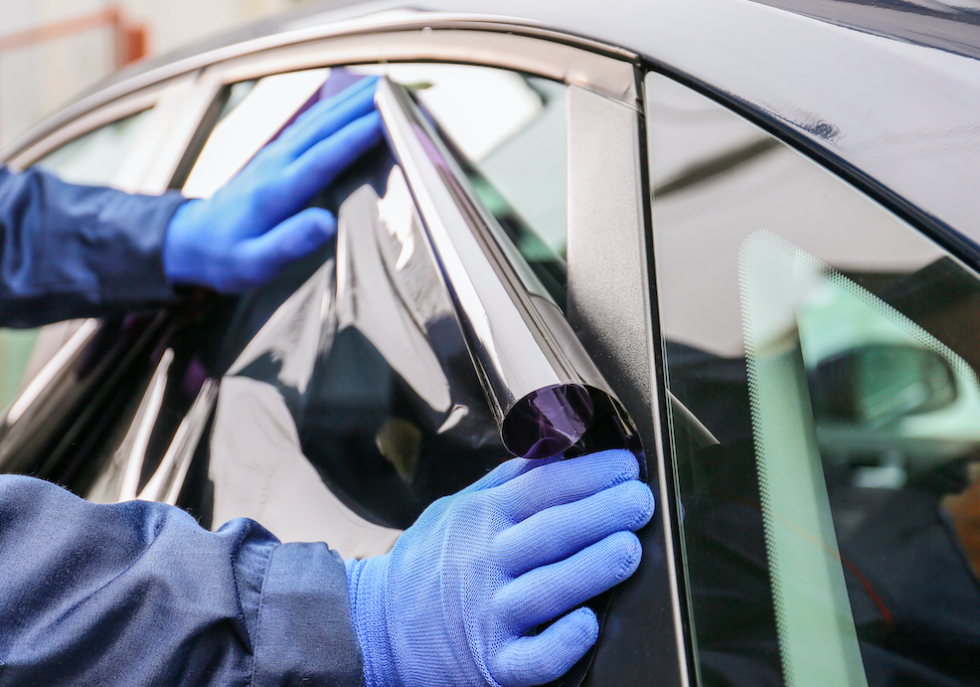
Regardless of where the vehicle is located, professional installation generally follows the same core process.
Step 1: Confirm the Film and Shade
The installer verifies what product is going on the vehicle.
Step 2: Clean the Glass
Dirt, oil, and contamination need to be removed carefully.
Step 3: Size and Shape the Film
Film is fitted to each piece of glass.
Curved automotive glass may require controlled heat shaping.
Step 4: Apply Installation Solution
Automotive film is generally installed using a water-based slip solution that allows positioning.
Step 5: Position the Film
The film is applied to the interior glass surface and aligned carefully.
Step 6: Squeegee the Film
The installer removes installation solution and air from beneath the film.
Step 7: Finish the Edges
Edges are trimmed or finished according to the vehicle and installation method.
Step 8: Inspect the Installation
The installer checks fit, appearance, edges, and visibility.
These fundamentals matter whether the installer works in a shop or at your location.
14. Final Inspection Matters in Both Settings
The customer should receive a final quality check.
Luxury Glass Tinting’s current mobile process includes checking:
- Appearance across the windows
- Edges
- Overall finish
- Visibility
- Curing guidance
The International Window Film Association also publishes visual-inspection guidance recognizing that professionally installed automotive film should be evaluated after application while allowing for temporary moisture-related curing effects.
A good installer should distinguish between an actual defect and normal curing.
15. Fresh Tint Will Need Time to Cure Either Way
Mobile tint does not cure differently simply because it was installed at your home.
Tint-shop film does not become fully cured because the car was inside a building.
Automotive film is installed using moisture, and some residual moisture may remain between the film and glass after installation.
During the drying period you may temporarily notice:
- Haze
- Moisture patterns
- Small water pockets
- Slight optical distortion
These can be normal.
IWFA explains that drying time depends on factors including the film, temperature, climatic conditions, and vehicle storage.
Follow the installer’s instructions instead of assuming every installation will be fully cured after exactly 24 hours.
16. Do Not Roll Down Freshly Tinted Windows Too Soon
After installation, the adhesive needs time to establish its bond while residual moisture dries.
Rolling down a window too soon can interfere with the film.
Your installer should tell you when the windows can safely be operated.
IWFA recommends avoiding unnecessary force or rolling windows down during the curing period.
The correct waiting period depends on the installation and conditions.
17. California Tint Laws Apply to Both Mobile and Shop Installations
The law does not change because the installer comes to your house.
Mobile and shop installers still need to consider the same California vehicle-window requirements.
Current California Vehicle Code §26708 includes specific rules for the windshield and front side windows.
For qualifying clear front-side-window material, the current law requires the material itself to have at least 88% Visible Light Transmission, while the glass-and-film combination must meet the referenced 70% minimum light-transmission requirement, along with additional conditions.
The current wording became effective January 1, 2026.
Rear-side windows and rear glass are treated differently.
A professional installer should discuss compliance before installing a shade on regulated windows.
18. Customer Reviews Matter—but Read Them Carefully
Reviews can help evaluate either a mobile provider or traditional tint shop.
Look beyond the star rating.
Useful reviews mention:
- Installation quality
- Clean edges
- Customer communication
- Film knowledge
- Long-term film performance
- Warranty handling
- Mobile punctuality
- Professional setup
- Aftercare support
Pay particular attention to recent reviews and examples involving vehicles similar to yours.
One review saying “great tint” provides less information than repeated feedback describing workmanship and service over time.
19. Warranty Matters More Than Installation Location
Before booking either option, ask about the written film warranty.
The International Window Film Association recommends asking professional dealers about product life, warranty coverage, references, and their experience before purchasing window film.
Questions should include:
- Who manufactures the film?
- What exact film series is being installed?
- What does the warranty cover?
- Who handles a future warranty issue?
- Does the warranty remain valid with mobile installation?
- What paperwork will I receive?
A premium product with clear manufacturer support can provide greater confidence than a generic film with vague claims.
Mobile Window Tinting Is Best When…
Mobile service may be your better choice when:
- Convenience is your highest priority
- You have a suitable home garage or parking area
- Your workplace permits vehicle service
- You want to avoid Los Angeles traffic
- You cannot easily leave your vehicle at a shop
- You know which film and shade you want
- Your vehicle is appropriate for on-site installation
- The weather and working conditions are suitable
A Tint Shop May Be Better When…
A traditional shop may make more sense when:
- Your location is dusty, windy, exposed, or cramped
- Weather conditions are poor
- You want to compare multiple products in person
- Your vehicle requires extensive old-film removal
- The installation is unusually complex
- You prefer dropping off the vehicle
- You want a dedicated indoor working environment
Neither list is absolute.
An experienced installer can recommend the best setup for your particular vehicle.
Mobile vs. Shop: Which Provides Better Tint Quality?
There is no universal winner.
A more useful equation is:
Quality film + skilled installer + clean preparation + suitable environment + proper technique + final inspection = quality tint installation
All six matter.
A shop has an inherent advantage in environmental predictability.
Mobile installation has an inherent advantage in customer convenience.
A professional mobile provider closes the environmental gap by preparing the work area and confirming that the location is appropriate.
Questions to Ask a Mobile Tinting Company
Before booking mobile service, ask:
- Do you service my area?
- Is my location appropriate for installation?
- Do I need covered parking?
- How much room do you need around the vehicle?
- Which film brands and series are available?
- Can I select ceramic or nano-ceramic film?
- What shades are available?
- What California restrictions apply?
- Is the warranty the same as an in-shop installation?
- What happens if weather makes installation unsuitable?
- Is final inspection included?
- What aftercare instructions will I receive?
Questions to Ask a Tint Shop
Before visiting a shop, ask:
- Do I need an appointment?
- How long can I expect to leave the car?
- What film brand do you install?
- Which film series are available?
- Can I compare samples?
- Is tint removal available?
- What warranty is included?
- What California requirements apply to my desired installation?
- Will I receive curing and aftercare instructions?
The same basic consumer standard should apply to both.
Common Mobile Window Tinting Myths
Myth: Mobile Tinting Is Always Lower Quality
False.
A professional mobile installer can produce excellent results when the working environment is appropriate.
Myth: Mobile Installers Have Better Environmental Control Than Shops
Generally false.
A dedicated shop typically has more predictable environmental control. Mobile quality depends more heavily on the selected location and setup.
Myth: Mobile Tinting Is Always More Expensive
False.
Pricing depends on the installer, film, vehicle, service area, and project.
Myth: Mobile Services Only Carry Basic Film
Not necessarily.
Film availability is provider-specific. Luxury Glass Tinting’s mobile process includes pre-appointment film and shade selection.
Myth: Shop Tinting Guarantees Better Work
False.
A building cannot compensate for poor workmanship or low-quality film.
Myth: Mobile Tinting Is Much Faster
Not necessarily.
It usually saves your travel and waiting time. The professional installation itself still requires proper preparation and application.
Frequently Asked Questions
Is mobile window tinting as good as tinting at a shop?
It can be. Quality depends on the installer, film, location, weather, cleanliness, and process. A dedicated shop generally offers more predictable environmental control.
Is mobile car tinting done in your driveway?
It can be, if the location is suitable. A clean private or covered garage may provide better conditions than a fully exposed driveway.
Do I need a garage for mobile window tinting?
Not necessarily. Luxury Glass Tinting currently requires a safe parking spot with room to access both sides of the vehicle. The provider can confirm whether the specific location is appropriate.
Can mobile installers use ceramic tint?
Yes, professional mobile services can install ceramic tint when the product is available and the location is suitable.
Does mobile tint cost more?
Not always. Pricing depends on the specific provider, vehicle, film, location, and installation requirements.
Does a tint shop have more film options?
Sometimes, because more inventory may be immediately available on-site. A mobile installer can still bring the exact premium product selected during booking.
Is mobile tinting faster?
It eliminates your travel to and from the shop, which can save considerable time. The actual professional installation still requires proper preparation and application.
What happens if it rains?
Suitability depends on the installation location. A protected garage may allow work to continue, while an exposed location may require a different arrangement.
Can mobile tinting be done at my workplace?
Yes, when the property permits it and there is a suitable parking area. Luxury Glass Tinting currently offers workplace appointments across most Los Angeles service areas.
Will mobile tint have the same warranty?
That depends on the product and provider. Confirm the exact written warranty before installation.
Which is cleaner: mobile tinting or a tint shop?
A dedicated shop generally has greater environmental control. A well-prepared enclosed mobile location can also support a clean installation. The condition of the actual workspace is what matters.
Is professional tinting completely bubble-free immediately?
Fresh tint can temporarily show moisture-related haze or water patterns while it dries. Persistent air bubbles, contamination, peeling, or edge problems are different issues.
How long does tint take to cure?
There is no universal cure time. Film construction, temperature, humidity, sunlight, and vehicle storage all affect drying.
Is mobile window tint legal in California?
The installation location is irrelevant to legality. The same California automotive window-film requirements apply whether tint is installed at your home, workplace, or a shop.
Final Verdict: Mobile Tinting or Tint Shop?
Choose mobile window tinting when convenience matters most and you have a clean, accessible location suitable for professional installation.
Choose a traditional tint shop when you prefer a dedicated indoor environment, your location is unsuitable, weather is an issue, or the vehicle requires more complex work.
For most customers, the more important choice is not mobile versus shop.
It is professional versus unprofessional.
Look for a provider that uses quality film, explains the specifications and shade options, understands California regulations, prepares the glass properly, works in suitable conditions, performs a final inspection, provides curing instructions, and stands behind the installation.
Luxury Glass Tinting provides professional mobile window tinting in Los Angeles for home and workplace appointments in most service areas, along with premium automotive window tinting options.
Its current automotive lineup includes LLumar dyed, ceramic, nano-ceramic, and virtually clear films, allowing the film to be selected according to heat rejection, UV performance, visibility, privacy, appearance, and budget rather than simply choosing the darkest tint.
The best option is the one that gives the installer the right conditions to do professional work while fitting comfortably into your schedule.