Glass makes modern homes and commercial spaces feel bright, open, and sophisticated. But clear glass does not always provide the privacy, visual interest, or branding opportunities a space needs.
Decorative window film offers a flexible way to transform existing glass without replacing it.
From frosted bathroom windows and elegant entry doors to branded conference-room partitions and patterned storefront glass, professional decorative window film can turn ordinary transparent surfaces into intentional design features.
For Los Angeles homes and businesses, decorative film is particularly useful when you want more privacy while preserving natural light, or when you want the appearance of etched, frosted, textured, or specialty glass without installing an entirely new glass system.
What Is Decorative Window Film?
Decorative window film is an architectural film applied to glass primarily to change its appearance, privacy level, or both.
Depending on the product, decorative film can create the look of:
- Frosted glass
- Etched glass
- Sandblasted glass
- Textured glass
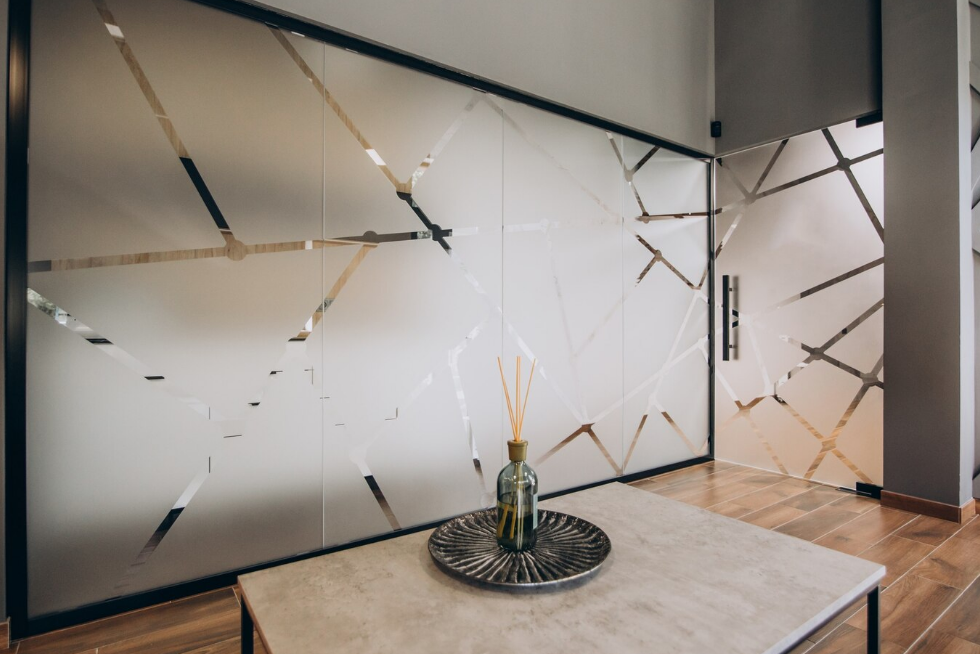
- Geometric patterns
- Gradients
- Colored glass
- Translucent surfaces
- Custom graphics
- Branded glass
Modern decorative films are available in many levels of transparency and visible-light transmission.
Some lightly diffuse the view while preserving a substantial amount of natural light. Others create much stronger visual privacy.
Manufacturers such as 3M currently offer decorative glass finishes specifically designed to control privacy and light while recreating the appearance of etched, cut, sandblasted, or textured glass.
Decorative Film Can Transform Glass Without Replacing It
One of the strongest advantages of decorative window film is that it works with existing compatible glass.
Instead of ordering custom etched or textured replacement glass, film can be professionally applied to the surface already in place.
That can make it useful for renovations, office upgrades, tenant improvements, bathroom remodeling, retail redesigns, and other projects where replacing functioning glass would add cost and disruption.
The finished appearance can range from very subtle to highly decorative.
For many projects, this allows property owners to change the look of their glass without changing the underlying architectural structure.
1. Add Privacy Without Eliminating Natural Light

Privacy is one of the most common reasons to install decorative film.
Traditional curtains, blinds, or solid walls can create privacy, but they may also block natural light or make spaces feel enclosed.
Frosted and translucent decorative films solve the problem differently.
They diffuse or obscure the view through the glass while still allowing daylight to pass.
This is particularly useful for:
- Bathrooms
- Entryways
- Front-door sidelights
- Shower glass
- Bedrooms
- Home offices
- Conference rooms
- Executive offices
- Reception areas
- Interior glass partitions
3M specifically positions its decorative glass finishes around maintaining natural light while providing adjustable levels of privacy.
Luxury Glass Tinting also currently offers white frost window film for bathrooms, office partitions, conference rooms, storefronts, and other areas where privacy is needed without making the space unnecessarily dark. (luxuryglasstinting.com)
2. Create the Look of Etched or Sandblasted Glass
Custom etched glass can create an elegant architectural finish, but replacing existing glass may not always be necessary.
Decorative film can reproduce many similar visual effects.
Frosted and matte products can create surfaces inspired by:
- Etched glass
- Sandblasted glass
- Dusted glass
- Textured glass
- Cut-glass patterns
3M’s current FASARA range specifically offers these types of visual effects while allowing designers to select different privacy levels and visible-light transmission.
This makes film useful when a homeowner or business wants a premium architectural appearance but prefers to retain the existing glass.
3. Give Bathrooms More Privacy
Bathrooms are one of the most practical residential uses for decorative film.
Clear bathroom windows can create privacy concerns, while blinds and curtains may be inconvenient in areas exposed to moisture.
Frosted window film can obscure the view through the glass while allowing daylight into the room.
It can be applied to suitable:
- Bathroom windows
- Shower enclosures
- Glass doors
- Interior partitions
Not every frosted pattern provides the same level of privacy.
A lightly diffused design may obscure details while still allowing silhouettes to remain visible. A denser white frost or opaque product can provide stronger visual screening.
If bathroom privacy is the primary goal, choose the film based on actual opacity rather than appearance alone.
4. Upgrade Front Doors and Entryways
Decorative glass can dramatically influence the appearance of an entrance.
Clear sidelights next to a front door may allow more visibility into a home than the occupants want.
Decorative film can add privacy while turning these narrow glass panels into a deliberate design feature.
Homeowners can choose subtle frost, geometric patterns, etched-style finishes, or stronger privacy options depending on the architecture.
Because daylight can still pass through many decorative films, the entrance can remain bright without remaining fully exposed.
5. Give Interior Glass Doors More Character
Interior glass doors are increasingly common in home offices, kitchens, living spaces, and contemporary renovations.
Decorative film allows these doors to remain visually lightweight while adding separation between rooms.
A home office, for example, might use a frosted band across the center of the door while leaving the upper and lower portions clearer.
This creates privacy around the work area without completely enclosing the room.
6. Improve Privacy in Glass-Walled Offices
Modern offices often use glass partitions because they preserve natural light and create a more open atmosphere.
The downside is visibility.
Conference rooms, executive offices, HR departments, consultation rooms, and other areas may require more privacy than clear glass provides.
Decorative film can create visual separation without replacing transparent partitions with solid construction.
Popular office options include:
- Full frost
- Partial frost
- Horizontal privacy bands
- Gradients
- Geometric patterns
- Custom decorative elements
For commercial interiors, the film can also help make glass walls easier to identify visually, which can complement broader architectural safety and wayfinding considerations.
7. Combine Branding With Interior Design
Businesses can use decorative film as more than a privacy solution.
Glass walls, doors, partitions, and storefront surfaces can become part of the brand environment.
Depending on the project and selected product, decorative applications may incorporate:
- Company logos
- Brand patterns
- Custom-cut graphics
- Privacy bands
- Reception-area designs
- Wayfinding elements
Luxury Glass Tinting currently describes its broader window-film offering as including decorative and custom-cut solutions for residential and commercial applications.
Custom work should still be evaluated based on the design, film, glass dimensions, and installation requirements rather than assuming every decorative film can be printed or cut in the same way.
8. Make Retail Glass More Visually Interesting
Retail businesses can use decorative film to control what customers see while creating a more intentional storefront or interior environment.
Film can be used for:
- Brand elements
- Partial screening
- Decorative patterns
- Fitting-room privacy
- Back-office screening
- Glass partitions
- Promotional areas
Permanent architectural film is often more suitable for long-term design features, while temporary static-cling or removable graphic materials may be preferable for short promotional campaigns.
Choosing the correct material depends on how long the design needs to remain in place.
9. Decorative Film Can Help Define Different Areas
Open interiors can feel spacious, but completely transparent glass does not always create enough separation.
Decorative film can visually define different zones without building solid walls.
For example, a restaurant might use patterned film to separate dining sections.
An office can use gradient frost around meeting rooms.
A home can use decorative film between living and work areas.
The glass still contributes to an open feeling, but the patterned or translucent surface creates a clearer sense of boundary.
10. Decorative Film Offers a Wide Range of Design Options
One reason decorative film is so versatile is the number of available finishes.
Frosted Film
Frosted film provides a soft, diffused appearance and is one of the most popular choices for privacy.
It works particularly well for bathrooms, office partitions, conference rooms, doors, and entry glass.
Matte Film
Matte finishes can create a subtle architectural appearance while reducing the transparency of clear glass.
Gradient Film
Gradient designs move between frosted and clearer sections.
They can be especially effective in offices where privacy is needed around eye level while maintaining greater transparency elsewhere.
3M’s current gradient decorative films are specifically designed to maintain light while providing targeted privacy without making a space feel completely closed.
Patterned Film
Patterns can include geometric, organic, fabric-inspired, architectural, and other designs.
These products turn the film into a genuine design element rather than merely a privacy treatment.
Textured-Look Film
Some decorative films create the appearance of textured or embossed glass.
3M currently offers embossed decorative finishes designed to diffuse light while creating visual texture.
Opaque Film
Opaque or near-opaque products provide stronger visual separation where preserving a view is not important.
White Frost Film
White frost offers a clean, contemporary appearance that works particularly well for bathrooms, office partitions, and professional interiors.
Does Decorative Window Film Block UV Rays?

Some decorative films provide UV reduction, but UV performance should not be assumed for every decorative product.
Decorative film is primarily chosen for appearance, privacy, or light diffusion.
If UV protection is also an important goal, ask for the published specifications of the exact product being considered.
Professional solar-control window films are specifically engineered for measurable solar and UV performance.
It is therefore better to select decorative film for decoration and privacy unless the manufacturer specifically documents additional UV performance.
Does Decorative Film Reduce Heat?
Not necessarily.
Some decorative films may reduce a portion of visible light or solar energy, but that does not make every decorative product a high-performance solar-control film.
If excessive heat is your main problem, consider residential window film designed specifically for heat control.
Luxury Glass Tinting’s current residential service separately lists solar films for glare and comfort alongside frosted and decorative options for entryways, showers, and interior glass.
This distinction is important.
A homeowner may need decorative frost on a bathroom window but ceramic or spectrally selective solar film on a large west-facing living-room window.
Is Decorative Film an Energy-Efficiency Product?
It can provide additional solar characteristics if the specific product is designed for them, but decoration alone does not guarantee meaningful energy savings.
Energy-oriented architectural films are evaluated using performance measurements such as:
- Solar Heat Gain Coefficient
- Total Solar Energy Rejected
- Visible Light Transmission
- U-value for relevant Low-E products
If reducing HVAC demand is the primary goal, choose film based on those specifications rather than selecting a decorative pattern and assuming it will lower energy bills.

Is Decorative Window Film the Same as Privacy Film?
There is significant overlap.
Many decorative films provide privacy, and many privacy films are decorative.
However, the categories are not identical.
A patterned film may provide only moderate screening, while an opaque privacy film may block almost all visibility.
The amount of privacy depends on:
- Pattern density
- Film opacity
- Visible-light transmission
- Viewing distance
- Interior and exterior lighting
Choose the film based on the level of screening you actually need.
Decorative Film vs. Reflective Privacy Film
Reflective privacy films operate differently from frosted decorative products.
Reflective film creates its strongest privacy when one side of the glass is significantly brighter than the other.
This makes it useful for daytime exterior privacy.
Frosted decorative film obscures the glass itself, so its privacy effect does not depend on creating the same strong light imbalance.
For bathrooms or conference rooms requiring consistent visual screening, frost is often the more straightforward solution.
For exterior windows where maintaining an outward view is important, reflective film may be more appropriate.
Decorative Film vs. Static Cling Film
Static cling films are excellent for temporary projects.
They can be particularly useful for renters, seasonal decorations, short-term promotions, and experimentation.
Professional decorative architectural films are generally designed for longer-term applications and can provide:
- Cleaner large-pane installation
- Greater durability
- Consistent finish
- More sophisticated patterns
- Professional customization
- Long-term commercial use
Static cling is ideal when easy removability is the priority.
Professional architectural film is usually better when the finished surface is intended to become part of the permanent interior design.
Is Decorative Window Film Removable?
Many professionally installed architectural films can be removed from compatible glass, but not all decorative films should be marketed as effortless peel-and-reuse products.
Adhesive-backed architectural film is different from non-adhesive static cling.
Professional removal may involve softening the adhesive, carefully peeling the material, and cleaning residue from the glass.
If future removal is important—for example, in a leased commercial space—discuss that requirement before choosing a product.
Does Decorative Film Provide Security?
Ordinary decorative film should not be treated as security window film.
Decorative products primarily address appearance and privacy.
Dedicated safety/security films are thicker engineered systems intended to help retain broken glass after certain impacts.
If the objective is forced-entry delay or broken-glass retention, request a dedicated window security film evaluation.
A decorative frost or pattern does not automatically make glass stronger or more resistant to breakage.
Does Decorative Film Prevent Glass From Shattering?
No.
This is another important distinction.
Decorative film may remain attached to pieces of broken glass depending on the product and incident, but it is not appropriate to describe ordinary decorative film as shatterproofing.
Safety/security film is specifically designed and tested for glass-retention applications.
Even dedicated security film does not make ordinary glass impossible to break.
Decorative Film for Residential Interiors
Residential decorative film works especially well where homeowners want privacy or visual interest without losing natural light.
Popular applications include:
- Bathrooms
- Shower enclosures
- Entry doors
- Sidelights
- Street-facing windows
- Kitchen glass
- Cabinet doors
- Home offices
- Interior partitions
Luxury Glass Tinting’s current residential service includes frosted and decorative options specifically for entryways, showers, interior glass, and privacy-focused applications.
Decorative Film for Commercial Interiors
Businesses can use decorative film strategically across several spaces.
Conference Rooms
Frosted or patterned film can provide privacy while allowing natural and borrowed light to continue moving through the office.
Glass Offices
Partial frost can obscure desks, monitors, or sensitive materials without completely enclosing employees.
Reception Areas
Decorative designs can reinforce the company’s visual identity.
Retail Stores
Patterns and branded elements can add visual interest to storefront and interior glass.
Restaurants
Film can divide seating areas or increase privacy without installing solid partitions.
Healthcare Offices
Frosted film can support visual privacy on appropriate glass surfaces.
Window film can contribute to a private physical environment but should not be described as creating regulatory compliance by itself.
Decorative Film Can Make Small Spaces Feel More Open
This is one of the less obvious design advantages.
Replacing glass with a solid wall creates complete separation but can also make small rooms feel enclosed.
Frosted decorative film allows the glass partition to remain.
Light continues to move through the space even when direct visibility is reduced.
This can be valuable in:
- Small offices
- Bathrooms
- Interior hallways
- Apartments
- Compact commercial interiors
The result is privacy without completely sacrificing openness.
How to Choose Decorative Window Film
Start with the desired outcome rather than choosing a pattern first.
If Privacy Is the Main Goal
Determine whether you need partial screening or near-complete visual obstruction.
If Daylight Is Important
Compare visible-light transmission and choose a translucent rather than opaque product.
If Design Is the Priority
Consider how the pattern will look from both sides of the glass and at different distances.
If Branding Is Required
Ask whether the design needs custom cutting, printing, color matching, or integration with existing signage.
If Heat or UV Performance Matters
Request the exact solar and UV specifications rather than assuming decorative film provides them.
If the Property Is Leased
Discuss eventual removal requirements before selecting the film.
Professional Decorative Window Film Installation
Small decorative-film projects can sometimes be attempted as DIY installations.
Professional installation becomes considerably more valuable on:
- Large panes
- Multiple matching windows
- High-visibility glass
- Conference rooms
- Storefronts
- Custom patterns
- Commercial interiors
- Complex glass shapes
Glass preparation is especially important.
Dust, fibers, contamination, inaccurate cuts, and uneven alignment become very noticeable on decorative film.
Luxury Glass Tinting’s current white-frost installation process includes thorough surface preparation, precise measuring and cutting, professional application, and final inspection of the edges and finish.
How Long Does Decorative Window Film Last?
There is no single lifespan that applies to every product.
Durability depends on:
- Film manufacturer
- Product construction
- Glass
- Interior or exterior installation
- Sun exposure
- Environmental conditions
- Cleaning
- Installation quality
Permanent architectural decorative films should be evaluated according to the manufacturer’s warranty and technical documentation.
Avoid relying on blanket claims that every decorative film will last a fixed number of years.
How Should Decorative Window Film Be Cleaned?
Once the film has cured, it should generally be cleaned gently.
Use:
- Soft microfiber cloths
- Soft synthetic sponges
- Non-abrasive cleaning products
Avoid:
- Abrasive pads
- Scraping tools
- Harsh chemicals not approved for the film
Follow the specific care instructions for the installed product.
Frequently Asked Questions
What is decorative window film?
Decorative window film is an architectural film applied to glass to change its appearance, privacy level, or light diffusion. Options include frosted, matte, patterned, textured-look, gradient, colored, and opaque finishes.
Does decorative window film provide privacy?
Yes, depending on the film. Frosted and opaque products can provide significant visual screening, while lighter patterns may provide partial privacy.
Does decorative film let natural light through?
Many decorative products are designed specifically to maintain natural light while obscuring views. The exact amount depends on the product’s visible-light transmission.
Is frosted film good for bathrooms?
Yes. Frosted film is one of the most popular options for bathroom windows because it can provide consistent privacy while maintaining daylight.
Can decorative film look like etched glass?
Yes. Modern decorative films can reproduce the appearance of etched, sandblasted, textured, and frosted glass without replacing the pane.
Can decorative film be used in offices?
Yes. Common office applications include conference rooms, executive offices, glass partitions, reception areas, and branded interior glass.
Can a company logo be incorporated into decorative film?
Custom-cut or branded decorative solutions may be available depending on the film and project. Discuss the artwork and installation requirements with the provider.
Does decorative film block UV rays?
Some products do, but UV performance is product-specific. Do not assume every decorative film provides significant UV rejection.
Does decorative window film reduce heat?
Some products may provide solar benefits, but decorative film should not automatically be treated as solar-control film. If heat reduction is the primary objective, compare purpose-built solar films.
Is decorative film a security film?
No. Decorative film is primarily used for appearance and privacy. Dedicated safety/security films are engineered for glass-retention applications.
Is decorative window film removable?
Many adhesive architectural films can be professionally removed, but removal characteristics vary. Static cling film is a separate category designed specifically for easier temporary use.
Is professional installation worth it?
Professional installation becomes especially worthwhile for large, highly visible, patterned, or commercial applications where alignment, edge finishing, and consistency are important.
Elevate Your Interior With Decorative Window Film
Decorative window film is one of the most flexible ways to transform glass without replacing it.
The right product can create privacy, texture, patterns, branding, light diffusion, and architectural character while allowing glass to remain an important part of the interior.
For homeowners, it can transform bathrooms, doors, entryways, partitions, and other glass surfaces.
For businesses, it can add privacy to conference rooms, create branded environments, improve reception areas, and make transparent office interiors more functional.
Luxury Glass Tinting provides professional decorative window film and white frost window film for Los Angeles homes and businesses, along with residential and commercial architectural-film solutions.
The most important step is to choose decorative film for what it actually does best: turning ordinary glass into a purposeful part of the design while providing the level of privacy and natural light your space needs.