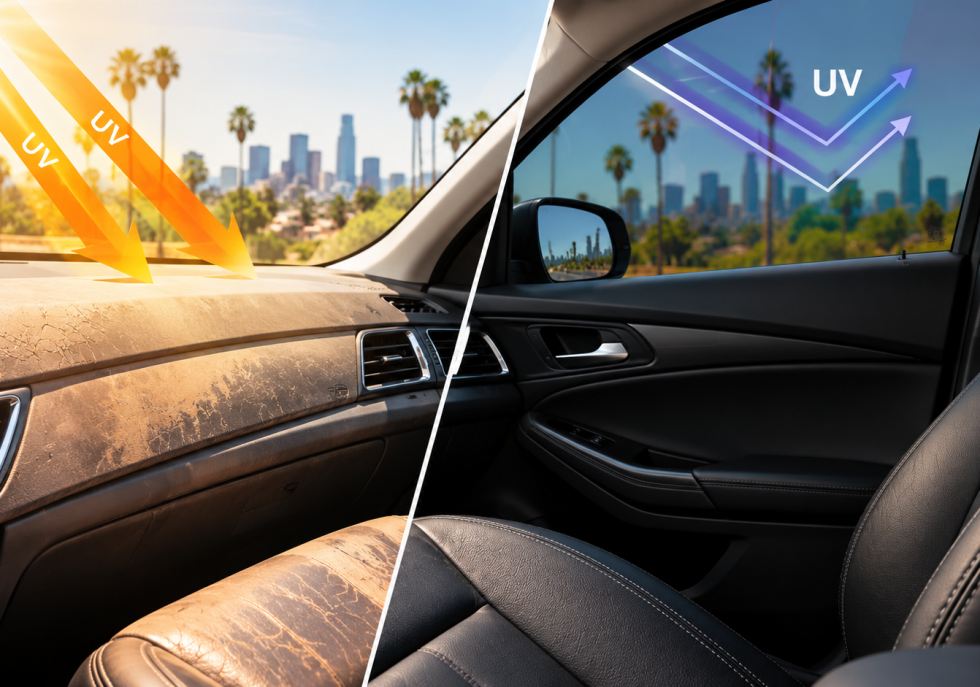
A daily drive through Los Angeles may feel like time spent indoors, but car glass doesn’t necessarily block every damaging ultraviolet ray. Sunlight reaching your face, hands, and arms through a side window can contribute to cumulative exposure, even when you do not feel hot or develop a sunburn. This is why window tint UV protection is worth considering alongside ordinary sun-care habits.
The short answer: a properly tested automotive window film can substantially reduce UV radiation passing through treated glass. Some products block 99% or more of measured UVA and UVB. However, tint cannot eliminate all sun exposure, guarantee prevention of skin cancer, or replace sunscreen, protective clothing and medical advice.
Can UV Rays Get Through Car Windows?
Yes. The answer depends on the kind of UV radiation and how the glass is made.
UVA wavelengths are associated with skin aging, pigmentation and long-term skin damage. UVA can pass through many ordinary side windows, although the amount varies substantially between vehicles.
UVB is more strongly associated with sunburn. Standard automotive glass generally blocks most UVB, which is one reason you might spend a sunny journey without burning while still receiving some UVA exposure.
Both UVA and UVB contribute to skin cancer risk. The American Cancer Society also notes that window exposure matters most for people who spend long periods near sunlit glass. Don’t assume that feeling comfortable means you’re not receiving UV radiation.
Why the Driver’s Side Window Deserves Attention
A laminated windscreen and a side window may look similarly transparent yet provide different levels of UV protection.
In a 2016 study published in JAMA Ophthalmology, researchers tested 29 vehicles from 15 manufacturers. Windscreens blocked an average of 96% of UVA, compared with 71% for driver-side windows. Individual side-window results ranged from 44% to 96%, demonstrating that factory glass protection is not uniform.
These figures describe the sampled cars, not every vehicle on the road. They also do not establish how much an individual’s skin cancer risk would change after installing film.
In American left-hand-drive vehicles, the left side of the driver’s face and left arm are often nearest the side glass. For passengers, seating position and the direction of sunlight determine exposure. Long commutes can add many small periods of sun exposure while driving, even if no single trip feels significant.
How Does UV-Blocking Window Film Work?
Automotive film is usually installed on the interior face of the glass. Depending on the product, specialized absorbers and film layers reduce the ultraviolet radiation transmitted through the window.
The principle is straightforward: less UVA and UVB reaching the occupant through the covered glazing means less exposure from that particular route. That is the main UV protection window tint benefit for skin.
It is important to separate UV protection from the other numbers on a film specification sheet:
- UV rejection: the percentage of specified UV radiation blocked in a laboratory test.
- VLT (Visible Light Transmission): the amount of visible light passing through; it determines how light or dark the glass appears.
- TSER (Total Solar Energy Rejection): a measure of overall solar energy rejected by the tested glazing.
- IRER (Infrared Energy Rejection): a measure relating to infrared heat, not a direct indicator of UV protection.
A dark film does not necessarily block more UV than a tested clear film. Equally, an impressive infrared rejection claim does not prove better skin protection. Look for product-specific UV test information.
What Does ‘99% UV Blocking’ Actually Mean?
Many premium automotive films advertise a window film UV blocking percentage of up to 99% or more. When supported by appropriate testing, that describes how much UV within the stated range the product or tested glazing blocks.
It does not mean you are 99% protected from every source of sunlight while inside the vehicle. UV can still enter through untreated glass, an open window or roof opening, and exposure continues whenever you step outside.
The Skin Cancer Foundation’s Seal of Recommendation provides one useful independent benchmark. Under its current requirements, qualifying window film and tint must block at least 99% of both UVA and UVB. The Seal is awarded to individual products that meet its criteria, not automatically to every film a manufacturer sells.
Ask the installer for the exact film name, relevant test results, and whether that specific product carries the Seal.
Can Window Tint Reduce the Risk of Skin Cancer?
Reducing exposure to harmful UV is consistent with established skin cancer prevention principles. However, window tint skin cancer claims need careful wording: laboratory UV rejection is not the same as clinical evidence that a given film prevents a particular percentage of skin cancers.
UV exposure is a recognized risk factor for skin cancers, including melanoma and non-melanoma skin cancers. Over time, it can also contribute to pigmentation changes and premature skin aging. A film that reduces transmission through the side glass may therefore be a useful additional protective measure, especially for people who drive regularly.
But individual risk depends on many factors, including lifetime exposure, skin characteristics, personal medical history and other protective habits. The American Academy of Dermatology recommends broad-spectrum, water-resistant sunscreen of SPF 30 or higher as part of a wider sun-protection routine.
For previous skin cancer, unusual photosensitivity or a condition requiring strict UV avoidance, speak to your dermatologist rather than relying on tint alone.
Clear, Dyed or Ceramic Tint: Which Protects Skin Best?
To protect skin in a car, start with proven UV rejection and legal placement, not darkness or the most expensive product tier.
Clear UV-protective film can preserve much of the original appearance while filtering UV. This makes it relevant to drivers who prefer lighter glass, subject to California’s exact glazing rules.
Dyed film is usually chosen for appearance, privacy, and glare reduction. A quality dyed product may still provide excellent UV filtering, even if its solar heat performance is more modest.
Ceramic tint uses engineered ceramic materials to control solar energy and often provides stronger heat rejection at comparable shades. That extra comfort is valuable during sunny commutes, but premium heat performance shouldn’t be mistaken for automatically superior UV protection.
Luxury Glass Tinting’s automotive window tinting service includes LLumar dyed, ceramic, nano-ceramic and nearly clear options. Compare the specifications of the actual film and shade, rather than assuming one category protects every occupant equally.
Is UV-Protective Window Tint Legal in California?
Skin protection does not override California’s window tint laws. Legal placement depends on the window and the installed material’s characteristics.
Under California Vehicle Code section 26708, a narrow exception permits clear, colorless, transparent UV-protective material on the front side windows when all conditions are satisfied. These include at least 88% VLT for the film itself, applicable federal requirements for the finished glass-and-film assembly, and a qualifying installer or manufacturer certificate kept with the vehicle.
The statute has separate restrictions for windscreens. A clear-looking film is not automatically authorized across the whole windscreen; a narrowly defined medical exception includes a dermatologist’s certificate and additional conditions. Rear-window and rear-side-window rules differ again.
Ask for an assessment of the exact vehicle, measurements where needed, and written compliance information before paying for film. Do not confuse a product labeled ‘70%’ with the different legal requirements for film and complete glazing.
How to Protect Your Skin During Long Commutes
Window film works best as one part of a consistent routine. For long commute sun exposure, the following precautions are practical:
- Choose broad-spectrum sunscreen. Use SPF 30 or higher on exposed skin, including your face, ears, neck, and hands, and follow the product instructions.
- Reapply when appropriate. Guidance commonly recommends reapplication at least every two hours during ongoing exposure, and after sweating or rubbing it off.
- Wear suitable clothing. Long sleeves or UPF-rated fabrics can protect arms without depending on glass coverage.
- Use UV-protective sunglasses. Glass and tint are not substitutes for adequate eye protection.
- Keep windows raised when relying on the film. Lowering a treated window creates a direct opening for sunlight.
- Consider other glazing. Rear passenger windows and sunroofs may also admit UVA, but you must assess suitability for film individually.
- Be careful with sunscreen storage. Products left in a very hot car may deteriorate; check storage guidance and expiry dates.
These habits matter even on cloudy days or when traveling in a vehicle with tinted windows.
Professional Installation and Film Verification
A dependable installation begins with identifying the film, inspecting the glass and confirming which windows may legally be treated. The installer should explain UV performance, optical clarity, warranty limitations, and aftercare instructions.
Fresh tint may require several days before you can lower side windows or clean the inside glass. Follow the film-specific timetable. Inspect poor adhesion, lifting edges, or film damage rather than trying to repair it with household tools.
For drivers comparing UV protection for car interiors and occupants, Luxury Glass Tinting also offers ceramic window tinting in the Los Angeles area. Ask for UV-rejection data for the chosen product, and confirm the legality of each window before installation.
Frequently Asked Questions About Window Tint UV Protection
1. Do UV rays enter a car when the windows are closed?
Yes. Most automotive glass blocks much of the UVB, but UVA can still pass through some side and rear glazing. Actual transmission depends on the glass’s construction and any existing treatment.
2. Does window tint block 99% of UVA and UVB?
Certain tested products do. The Skin Cancer Foundation requires qualifying window films to block at least 99% of both types. Check the specific product’s laboratory claims rather than assuming every tint meets this standard.
3. Can car window tint prevent skin cancer?
Tint can reduce UV exposure through treated glass, which supports sun protection. It cannot guarantee that skin cancer will be prevented or quantify an individual’s risk reduction. Continue recommended protective habits and seek medical advice when needed.
4. Is clear film as effective as dark tint for UV protection?
It can be. Visible darkness and UV rejection are different specifications. A tested clear film may provide high UV blockage, although its glare and heat performance can differ from darker products.
5. Are the driver’s face and arms more exposed to sunlight?
They can be, especially beside a side window during prolonged journeys. The side receiving the most sunlight changes with seat position, road direction, and time of day.
6. Does ceramic tint provide better skin protection than dyed film?
Not necessarily. Both film types can achieve high UV rejection. Ceramic films often offer stronger heat control; choose verified UV protection first, then compare comfort and appearance.
7. Should I still wear sunscreen in a tinted car?
Yes, especially when exposure continues before and after driving or through untreated windows. Dermatologists recommend broad-spectrum SPF 30 or higher as part of a comprehensive sun-protection approach.
8. Is UV window film allowed on California front windows?
Qualifying clear film may be permitted on front-side windows if strict statutory conditions are met, including 88% film VLT and certification. Windscreen rules are more restrictive. Have the proposed installation checked before booking.
Final Thoughts: Make Skin Protection Part of Your Drive
Window tint UV protection can reduce the amount of harmful ultraviolet radiation reaching drivers and passengers through treated glazing. Its greatest value is providing another consistent barrier during routine journeys—not promising complete protection or replacing everyday sunscreen.
If you commute regularly around Los Angeles or Culver City, contact Luxury Glass Tinting to discuss UV-tested LLumar film options, legal window coverage and a vehicle-specific quotation. Choose measured protection, clear visibility and professional installation over marketing claims alone.