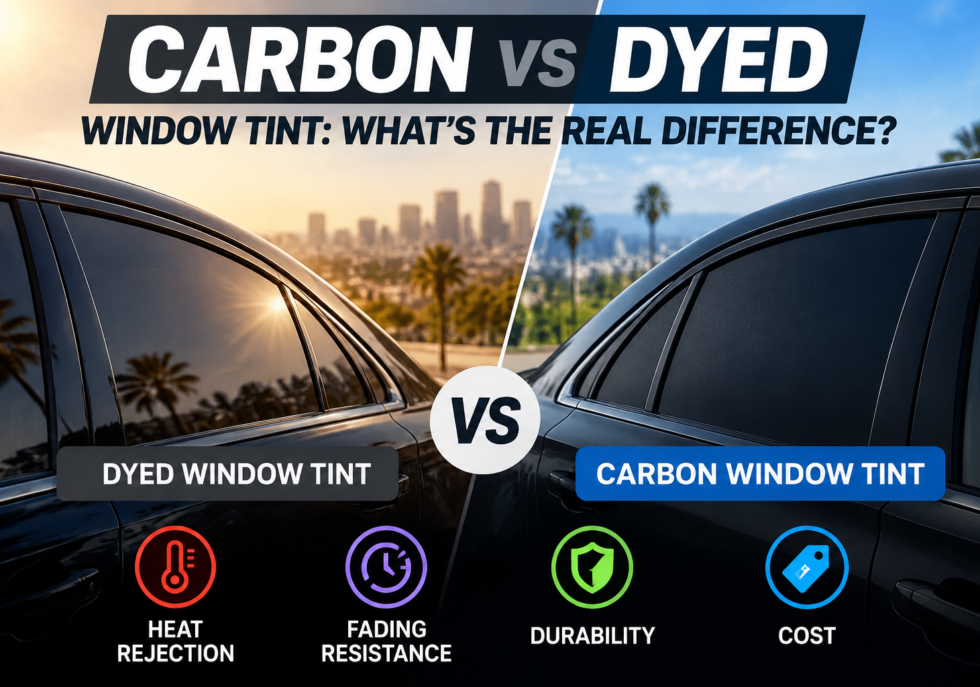
If you’re shopping for window tint on a budget, you’ll quickly narrow it down to two options: dyed film and carbon film. They sit close together on price, they both look dark and clean after installation, and they both add privacy. So why do tint professionals so often steer people toward carbon?
The answer comes down to what happens after the first summer. This guide breaks down carbon vs dyed window tint in plain terms, covering heat rejection, fading, durability, and cost, so you can decide whether dyed film is enough or whether carbon is the smarter buy.
Quick Answer: Dyed window tint is the cheapest option and works well for privacy and appearance, but standard dyed film absorbs heat and can fade over time. Carbon window film costs roughly $50 to $150 more on a typical sedan, rejects more infrared heat, never fades, and has a matte finish that lasts for years. For most drivers who want the best affordable window tint, carbon is the better value. Premium color-stable dyed films from brands like LLumar and XPEL narrow the gap on fading but still trail carbon on heat rejection.
Carbon vs Dyed Window Tint at a Glance
Feature | Dyed Window Tint | Carbon Window Film |
| How it works | Dye layer absorbs light | Carbon particles block infrared heat |
Heat rejection | Low | Moderate to good |
| Infrared (IR) rejection | Minimal | Noticeably higher |
UV protection | Up to 99% on quality films | Up to 99% |
| Fading | Standard dyed films fade over time | Does not fade |
Finish | Glossy to neutral | Matte, deep black |
| Signal interference | None | None |
Typical lifespan | 3–5 years (standard), longer for premium dyed | 10+ years |
Typical price (sedan) | $100 – $250 | $200 – $400 |
| Best for | Tight budgets, privacy, short-term ownership | Daily drivers wanting value and durability |
Prices reflect typical Los Angeles market ranges for a full sedan tint (side windows and rear glass). Final pricing depends on vehicle size and film brand.
What Is Dyed Film Window Tint?
Dyed film window tint is the most basic form of automotive tint. It’s made by adding a dye layer to a polyester film. That dye absorbs part of the visible light passing through the glass, which darkens the windows, reduces glare, and increases privacy.
Because it’s simple to produce, dyed car window tint is the lowest-cost option at most tint shops. It looks great right after installation and gives any vehicle a cleaner, more custom look.
Is It Vinyl? Clearing Up “Dyed Vinyl Window Tint”
Many people search for “dyed vinyl window tint,” but automotive window tint isn’t actually vinyl. Quality tint is made from polyester (PET) film, which is optically clear, stable, and designed to bond to glass with a pressure-sensitive adhesive. Vinyl is used for car wraps and graphics, not window film. If a product is sold as “vinyl window tint,” it’s usually a low-grade novelty or static-cling product, not something you want on your vehicle’s glass.
Dyed Tint Problems You Should Know About
Standard dyed film has a few well-known weaknesses. Understanding these dyed tint problems is the best way to decide whether it’s right for you.
1. Dyed Tint Fading
Dyed tint fading is the most common complaint. The sun’s UV rays gradually break down the dye molecules, and the film slowly shifts toward purple or brown. You’ve probably seen older cars with purple rear windows. That’s aged dyed film.
2. Low Heat Rejection
Dyed film absorbs solar energy rather than blocking infrared heat. The glass heats up, and much of that heat radiates into your cabin. Your windows look dark, but the car doesn’t feel much cooler.
3. Bubbling and Peeling
As lower-grade dyed film ages, the adhesive can break down, leading to bubbles, lifted edges, and peeling, especially in hot climates.
4. Reduced Clarity Over Time
Aging dyed film can develop haze, which is most noticeable at night when headlights and streetlights create glare.
How Long Does Dyed Window Tint Last?
Standard dyed tint typically lasts 3 to 5 years before fading or failing. In Southern California, where cars sit in strong sunlight most of the year, lower-grade dyed films often land at the short end of that range. Premium color-stable dyed films last considerably longer, as covered below.
What Is Carbon Window Film?
Carbon window film uses carbon particles blended into the film layers instead of relying on dye alone. Carbon is excellent at blocking infrared light, the part of sunlight responsible for the heat you feel on your skin. That’s what makes carbon a true performance step up from dyed film rather than just a darker look.
Carbon film has a distinctive matte black finish that many drivers prefer because it looks deep and rich without the shiny or mirrored appearance of metallic films. Because carbon contains no metal, it won’t interfere with phones, GPS, Bluetooth, or keyless entry.
Carbon Tint Benefits
Here are the main carbon tint benefits that make it the most popular mid-range window tint:
- Better heat rejection. Carbon blocks significantly more infrared heat than standard dyed film, so your cabin stays cooler and your AC works less.
- Excellent tint color stability. Carbon particles don’t break down in sunlight, so the film won’t fade or turn purple.
- Matte, premium look. The deep black finish looks high-end on nearly every paint color.
- No signal interference. Non-metallic construction keeps all electronics working normally.
- Strong UV protection. Quality carbon films block up to 99% of UV rays, protecting your skin and interior.
- Longer lifespan. Carbon typically lasts 10 years or more with proper care.
- Reasonable price. It delivers real performance gains without the higher price of ceramic film.
Carbon vs Dyed Heat Rejection: How Big Is the Difference?
This is where the comparison matters most for drivers in hot climates. Here’s a general look at carbon film heat rejection compared with dyed and ceramic options:
Performance Metric | Standard Dyed | Premium Color-Stable Dyed | Carbon | Ceramic |
| Total Solar Energy Rejected (TSER) | ~25–40% | ~35–45% | ~40–50% | ~45–65% |
Infrared Rejection | Low | Low to moderate | Moderate to good | High to very high |
| UV Rejection | Up to 99% | Up to 99% | Up to 99% | Up to 99% |
These are general industry ranges. Actual numbers vary by brand, product line, and shade, so always ask your installer for the specific spec sheet.
The takeaway is simple: in a carbon vs dyed heat rejection matchup, carbon wins. Dyed film mostly reduces brightness, while carbon actually reduces the heat coming through your glass. If you park outside or commute during the hottest part of the day, you’ll feel that difference.
Window Tint Durability Comparison
Durability is the other big factor. Here’s how different films compare over time:
| Film Type | Typical Lifespan | Fades? | Common Failure |
| Standard Dyed | 3–5 years | Yes | Purple color shift, bubbling |
| Premium Color-Stable Dyed | Many years, often lifetime warranty | Resistant | Minimal when professionally installed |
| Carbon | 10+ years | No | Rare |
| Ceramic | 10+ years to lifetime | No | Rare |
This window tint durability comparison shows why the cheapest option isn’t always the cheapest over time. Replacing faded dyed tint means paying for removal plus new film, which often costs more than choosing carbon from the beginning.
Not All Dyed Tint Is the Same: Brand-Name Dyed Films
Here’s something many comparison articles miss: premium dyed films from major manufacturers perform very differently from cheap, unbranded dyed tint. If you’re set on a dyed film, choosing a quality brand solves the biggest problem, which is fading.
LLumar ATC Dyed Window Tint
LLumar dyed window tint is one of the most trusted entry-level options on the market. LLumar positions ATC as an affordable, scratch-resistant dyed tint that blocks over 99% of UV rays to help protect interior surfaces from cracking and fading. According to LLumar, ATC’s charcoal color is built into the film rather than applied only on the surface, which the brand says improves durability and color stability, and it comes in seven shades.
That construction is what separates a quality ATC dyed window tint from bargain-bin film. It’s still a dyed film, so heat rejection is modest, but its color stability is far better than generic dyed products. As a LLumar Select Pro installer, Luxury Glass Tinting can walk you through ATC and compare it with LLumar’s higher-performance films on your actual vehicle.
XPEL Dyed Window Tint (PRIME CS BLACK)
XPEL dyed window tint comes in the form of the PRIME CS line. XPEL lists PRIME CS as a color-stable dyed film with up to 35% infrared heat rejection, 99% UV blocking, a lifetime XPEL warranty, and no signal interference. XPEL also notes that all PRIME window tint comes with a lifetime transferable warranty.
What Is the Best Dyed Window Tint?
The best dyed window tint is one made by an established manufacturer with color-stable construction, strong UV protection, and a real warranty against fading, bubbling, and peeling. LLumar ATC and XPEL PRIME CS are both solid examples. What you should avoid is unbranded dyed film with no written warranty, since that’s where most fading and bubbling complaints come from.
Even the best dyed film, though, is still a dyed film. If heat rejection is your priority, carbon or ceramic will outperform it.
What About “Carbon Dyed Window Tint”?
Some films are marketed as “carbon dyed window tint” or dyed-carbon hybrids. These combine a dye layer with carbon particles to improve color stability and add some infrared blocking at a lower price than pure carbon film.
Carbon dyed films can be a reasonable compromise, but performance varies widely between products. Always ask for the spec sheet and compare the infrared rejection and TSER numbers, rather than relying on the word “carbon” in the product name.
Upgrading from Dyed Tint: Is It Worth It?
If your car already has dyed film and it’s starting to fade, bubble, or turn purple, upgrading from dyed tint is usually worth it. Here’s what the process looks like.
Step 1: Removal. Your installer steams and peels the old film, then removes adhesive residue. Removal typically adds $100 to $250 depending on the vehicle and the condition of the old film. Rear windshields with defroster lines require extra care so the lines aren’t damaged.
Step 2: Choose your upgrade. Carbon is the natural next step for budget-conscious drivers who want better heat rejection and no fading. If you want maximum comfort, ceramic is the top-tier window tint upgrade.
Step 3: Professional installation. New film is cut, heat-formed, and applied. Most installations take one to three hours.
Signs it’s time to upgrade:
- Your windows have turned purple or brown
- You see bubbles, peeling edges, or haze
- Your car still feels hot inside despite dark tint
- Your current tint is darker than California law allows on the front windows
Best Affordable Window Tint: Budget Options Compared
If you’re searching for the best affordable window tint, here’s a practical breakdown of your options:
Unbranded dyed film ($100–$150): Lowest price, but expect fading and a short lifespan. Only suitable if you plan to sell the car soon.
Premium branded dyed film ($150–$300): Good color stability and warranty coverage with modest heat rejection. A smart pick if you mainly want privacy and a clean look.
Carbon film ($200–$400): The best balance of price, performance, and durability. Real heat reduction, no fading, and a long lifespan.
Entry-level ceramic ($300–$500): A step above carbon for drivers who want strong heat rejection without paying for top-tier ceramic.
For most Los Angeles drivers who want to keep costs reasonable, carbon film or entry-level ceramic offers the most comfort per dollar.
Carbon or Dyed: Which Should You Choose?
Choose dyed window tint if:
- Your budget is your top priority
- You mainly want privacy and a darker look
- You park in a garage or shaded area most of the time
- You’re leasing the car or plan to sell it soon
- You choose a color-stable branded film with a real warranty
Choose carbon window film if:
- You want noticeable heat reduction without paying for ceramic
- You drive daily and park outdoors
- You want a matte black finish that won’t fade
- You plan to keep your vehicle for several years
- You’re replacing faded dyed tint and want a lasting upgrade
In a climate like Southern California, where heat and UV exposure are constant, carbon typically delivers better long-term value than standard dyed film.
A Quick Note on California Tint Laws
Whichever film you choose, California’s rules still apply. Front side windows must allow a high percentage of visible light through, windshield tint is limited to a strip at the top, and rear windows can be darker when the vehicle has dual side mirrors. Since the front windows can’t go dark, heat rejection matters more than darkness, which is another reason carbon and ceramic films are popular with LA drivers. Always confirm current regulations with the California DMV or your installer before choosing a shade.
Frequently Asked Questions
What is the difference between carbon and dyed window tint?
Dyed tint uses a dye layer that absorbs light to darken the windows, while carbon tint uses carbon particles that block infrared heat. Carbon rejects more heat, does not fade, and lasts longer than standard dyed film.
Is carbon tint better than dyed tint?
For most drivers, yes. Carbon tint offers better heat rejection, superior color stability, and a longer lifespan for a modest price increase. Dyed tint is mainly better when the lowest upfront cost is the priority.
Does dyed window tint fade?
Standard dyed tint fades over time as UV rays break down the dye, often turning purple or brown. Premium color-stable dyed films from brands like LLumar and XPEL are built to resist fading.
How long does carbon window tint last?
Quality carbon window film typically lasts 10 years or more when professionally installed and properly maintained.
Is LLumar ATC a good window tint?
LLumar ATC is a well-regarded entry-level dyed film with strong UV protection and color-stable construction. It’s a good choice for privacy and appearance on a budget, though carbon and ceramic films offer more heat rejection.
Is window tint made of vinyl?
No. Automotive window tint is made from polyester (PET) film. Vinyl is used for car wraps and graphics, not window film.
Can I put carbon tint over old dyed tint?
No. Old film should always be removed first. Installing new film over old tint causes adhesion problems, poor clarity, and bubbling.
Get the Right Tint for Your Budget
The real difference between carbon vs dyed window tint comes down to performance over time. Dyed film gives you privacy and style at the lowest cost, while carbon adds real heat rejection and color stability that lasts for years. And if you do go with dyed, choosing a premium brand makes a meaningful difference.
At Luxury Glass Tinting, our master certified installers serve drivers across Culver City, Santa Monica, Beverly Hills, Pasadena, and greater Los Angeles, with in-shop and mobile installation. We’ll show you real film samples, explain the performance differences, and give you a clear, upfront price.
Call 310-925-0780 today to get a free quote and find the right tint for your car and budget.