
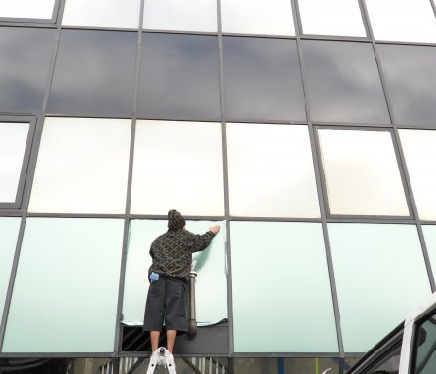
Los Angeles businesses often rely on glass to make commercial spaces feel bright, modern, and inviting.
Office towers use large windows to bring daylight into workspaces. Retail storefronts depend on clear glass to showcase merchandise. Restaurants and hospitality properties use expansive glazing to create atmosphere and connect indoor spaces with the city outside.
But glass can also create an expensive comfort problem when it receives strong California sunlight.
Sun-exposed commercial windows can contribute to:
- Excess solar heat gain
- Hot perimeter offices
- Afternoon temperature imbalances
- Screen glare
- Greater cooling demand
- UV exposure to furnishings and merchandise
- Reduced comfort near the glass
Commercial window film offers a retrofit strategy for reducing many of these problems without automatically replacing otherwise serviceable windows.
A properly selected solar-control film can begin reducing incoming solar energy as soon as it is installed.
For a large, glass-heavy commercial property, reduced cooling demand can potentially translate into meaningful operating savings over time—and in some projects, cumulative savings may reach thousands of dollars.
But no responsible installer should promise that every Los Angeles business will save the same amount.
Actual savings depend on:
- Building size
- Amount of glass
- Window orientation
- Existing glazing
- Solar exposure
- Film selected
- HVAC efficiency
- Operating hours
- Thermostat settings
- Utility rates
- Occupancy
Luxury Glass Tinting provides professional commercial window tinting in Los Angeles for offices, retail spaces, restaurants, hospitality properties, commercial buildings, and other sun-exposed facilities.
The best commercial tint project starts with one question:
What problem is the glass actually creating?
Quick Answer: Can Commercial Window Tinting Reduce Energy Costs?
Yes, potentially.
Solar-control window film can reduce the amount of solar energy passing through treated glazing and becoming heat inside the building.
If less unwanted solar heat enters, the cooling system may have less heat to remove.
That can reduce cooling demand.
However:
Reduced solar heat does not equal a guaranteed percentage reduction in the total utility bill.
A building’s energy use may also include:
- Lighting
- Computers
- Equipment
- Refrigeration
- Ventilation
- Water heating
- Plug loads
- Heating
- Other mechanical systems
The strongest financial case comes from evaluating the actual building rather than applying a generic internet savings percentage.
Correcting the “30% Energy Loss Through Windows” Claim
A frequently repeated statistic says approximately 25%–30% of heating and cooling energy is associated with heat gain and loss through windows.
That U.S. Department of Energy statistic is commonly published in residential window guidance.
It should not be rewritten as:
“Commercial businesses lose 30% of their cooling costs through untreated glass.”
The Department of Energy does, however, identify windows as an important contributor to whole-building energy performance and specifically recognizes retrofit film as one method for reducing solar heat gain.
For commercial properties, the amount of energy affected by the windows depends on the specific building.
Why Windows Matter to Commercial Energy Performance
The Department of Energy notes that windows influence multiple building energy uses and can play a substantial role in both energy consumption and occupant comfort.
When strong sunlight reaches commercial glazing, solar radiation can be:
- Reflected
- Absorbed by the glass
- Transmitted into the building
The transmitted energy reaches:
- Floors
- Desks
- Walls
- Furniture
- Merchandise
- People
Those surfaces absorb solar energy and warm up.
The result can be a noticeable increase in heat around the window line.
Why Perimeter Offices Often Feel Hotter
One of the most common commercial comfort complaints is:
“The thermostat says the building is cool, but the offices beside the windows are still hot.”
That happens because thermostat temperature and localized solar exposure are not necessarily the same thing.
A conference room with large west-facing windows may receive strong afternoon sunlight while an interior hallway receives almost none.
The HVAC system may therefore be trying to condition zones with very different heat loads.
Window film can target the solar component at the glazing.
Window Orientation Matters
Different elevations can behave differently.
West-Facing Windows
Often receive strong afternoon solar exposure.
These may be particularly problematic for:
- Offices
- Restaurants
- Conference rooms
- Retail spaces
East-Facing Windows
May create intense morning glare and heat.
South-Facing Windows
Can receive substantial solar exposure depending on:
- Season
- Overhangs
- Surrounding buildings
- Exterior shading
North-Facing Glass
May have lower direct solar exposure, although local conditions still matter.
A commercial building therefore does not necessarily need the same film on every façade.
What Is Solar Heat Gain Coefficient?
One of the most important performance metrics for commercial glazing is Solar Heat Gain Coefficient, or SHGC.
SHGC represents the fraction of solar radiation admitted through a glazing system and ultimately released as heat indoors.
It ranges from 0 to 1.
Generally:
Lower SHGC = less solar heat gain.
For a Los Angeles commercial property where cooling is the primary concern, lower solar heat gain can be an important target.
What Is TSER?
Total Solar Energy Rejected, or TSER, is another useful metric.
It represents the percentage of total solar energy rejected by the glass-and-film system.
Generally:
Higher TSER = more total solar energy rejected.
TSER provides a broader indication of solar performance than looking only at tint darkness.
What Is Visible Light Transmission?
Visible Light Transmission, or VLT, tells you how much visible light passes through the filmed glass.
Higher VLT usually means:
- Brighter interiors
- Lighter-looking windows
Lower VLT usually means:
- Darker glass
- More visible-light reduction
- Often stronger glare control
VLT should be considered alongside SHGC and TSER.
Darker Film Does Not Automatically Mean Better Energy Performance
A common mistake is assuming:
darkest film = strongest heat rejection.
That is not necessarily true.
Modern commercial films use different technologies to manage solar energy.
A lighter:
- Ceramic film
- Spectrally selective film
- Specialty solar film
may provide strong heat performance while preserving substantially more visible light.
That can be particularly important for:
- Retail storefronts
- Luxury offices
- Restaurants
- Hotels
- Showrooms
- Client-facing spaces
where darkness would negatively affect design or visibility.
Infrared Rejection Is Not the Same as Total Heat Rejection
Commercial films are often advertised with very large infrared-rejection percentages.
IR performance can be useful.
But infrared radiation is only part of the solar spectrum.
A film advertised as rejecting a high percentage of a particular infrared range is not necessarily rejecting that same percentage of total solar energy.
For energy-focused projects, compare:
- SHGC
- TSER
- VLT
- IR performance
- Visible reflectance
together.
How Commercial Window Film Works
Commercial solar-control films modify how glass interacts with sunlight.
Depending on the film technology, the glazing system may:
- Reflect more solar energy
- Absorb solar energy differently
- Transmit less solar heat
- Reduce visible glare
- Reduce UV transmission
Different films create different balances.
That is why commercial window-film selection should not start with:
“Give me the darkest tint.”
It should start with:
“What combination of heat control, daylight, privacy, glare reduction, and appearance does this building need?”
Does Window Film Start Working Immediately?
Yes, in terms of solar performance.
Once the film is installed and sunlight reaches the treated glass, it immediately changes the glazing’s:
- Solar transmission
- Reflection
- Absorption
- Visible-light transmission
Occupants may notice a difference in:
- Window-line heat
- Glare
- Brightness
- Comfort
soon after installation.
Financial savings are different.
Energy Savings Appear Over Time
Electricity savings are measured through future energy consumption.
A business should not expect to install film at noon and know by the afternoon exactly how many dollars it has saved.
A useful post-installation evaluation may consider:
- Monthly electricity use
- Weather differences
- Occupancy
- Business hours
- HVAC scheduling
- Thermostat settings
before and after the retrofit.
For a larger building, energy modeling can provide a stronger estimate before installation.
Can Commercial Window Tint Save Thousands?
For some commercial properties, potentially.
Consider a large building with:
- Extensive sun-exposed glass
- Significant cooling demand
- Long operating hours
- High electricity consumption
Reducing the window-related solar load could produce meaningful cumulative operating savings.
In that context, savings over time could reach thousands of dollars.
But a small storefront with limited glazing and low HVAC use will have a completely different financial profile.
That is why the title’s “saves businesses thousands” should be treated as a possible project outcome, not a guarantee for every customer.
Avoid Generic “15%–30% Energy Savings” Guarantees
The original article suggests businesses can automatically save 15%–30% on total energy costs.
That is too broad.
Industry studies and individual projects can produce impressive savings.
But results depend on the building.
A defensible energy estimate should account for:
- Climate
- Existing glass
- Window-to-wall ratio
- Window orientation
- Existing shading
- Film
- HVAC
- Occupancy schedule
- Utility costs
A building-specific analysis is far more credible than multiplying a company’s current utility bill by a generic percentage.
Commercial Window Film vs. Window Replacement
Film is attractive partly because it can improve the solar performance of existing glazing without replacing the entire window assembly.
That can mean:
- Less construction
- Less demolition
- Shorter project scope
- Reduced disruption
- Ability to treat selected elevations
But film and window replacement do not solve identical problems.
When Window Replacement May Be Better
Window film cannot repair:
- Failed insulated-glass seals
- Cracked panes
- Major air leakage
- Deteriorated frames
- Water intrusion
- Structural problems
If the existing window system is physically failing, repair or replacement may need to come first.
Film is most compelling when the existing glazing is serviceable but its:
- Solar performance
- Glare control
- Privacy
- Appearance
could be improved.
Current Commercial Window Film Options
Luxury Glass Tinting currently offers a broad selection of commercial solar-control films.
Options include:
- Reflective window film
- Dual-reflective window film
- Deluxe window film
- Neutral window film
- Specialty window film
- Ceramic window film
- Exterior window film
- Harmony window film
- Low-E window film
- Spectrally selective window film
Different products suit different buildings.
Reflective Window Film
Reflective film is designed for strong solar-control performance.
Potential benefits include:
- Heat rejection
- Glare reduction
- Daytime privacy
- Uniform exterior appearance
The trade-off is increased reflectivity.
For some modern commercial buildings, that is desirable.
For others, it may conflict with:
- Architecture
- Storefront transparency
- Brand appearance
Dual-Reflective Film
Dual-reflective film typically combines:
- A more reflective exterior
- A more neutral interior surface
This can provide strong solar control while reducing the mirror-like interior appearance experienced with some traditional reflective films.
It can be particularly useful in:
- Restaurants
- Offices
- Hospitality spaces
- View-oriented properties
where nighttime outward visibility matters.
Deluxe Commercial Film
Luxury Glass Tinting currently offers a deluxe commercial film intended for:
- Heat rejection
- Glare reduction
- Lower-reflective appearance
This may work well where strong solar performance is needed without a heavily mirrored façade.
Neutral Commercial Film
Neutral film is designed to preserve a more natural glass appearance.
It can be a good option for businesses prioritizing:
- Heat control
- Glare reduction
- Understated design
instead of a highly reflective exterior.
Ceramic Commercial Window Film
Ceramic film can provide strong solar performance with relatively low reflectivity.
It is often considered for:
- Executive offices
- High-end retail
- Coastal properties
- Customer-facing spaces
where both optical clarity and heat control matter.
Luxury Glass Tinting currently includes ceramic architectural film among its commercial choices.
Ceramic Is Not Automatically the Best Commercial Film
Ceramic is premium technology, but no one film type wins every project.
Reflective film may provide a stronger combination of:
- Solar control
- Daytime privacy
for some properties.
Spectrally selective film may be better where preserving daylight is crucial.
Low-E film may be more appropriate if year-round thermal performance matters.
The building should drive the recommendation.
Spectrally Selective Film
Spectrally selective film is especially useful for buildings where the customer wants:
less solar heat without dramatically darkening the glass.
It is designed to preserve comparatively high visible-light transmission while reducing significant solar energy.
This can be valuable for:
- Retail storefronts
- Showrooms
- Historic-style buildings
- Luxury offices
- Properties with important views
Luxury Glass Tinting currently describes its spectrally selective commercial film as providing strong heat protection with minimal light reduction.
Specialty Window Film
Specialty commercial film provides another option when optical clarity matters.
Luxury Glass Tinting currently positions specialty film around virtually invisible solar-control benefits and high optical clarity.
This may be particularly useful when a property owner says:
“We need better performance, but we cannot significantly change the appearance of the façade.”
Harmony Film
Harmony film combines solar-control technology with:
- Low reflectivity
- A warmer visual appearance
This can fit architectural environments where conventional gray or mirrored tint would feel visually inconsistent.
Low-E Commercial Film
Low-E means low emissivity.
Low-E film is designed to influence radiant heat transfer through the glazing.
Depending on the product and existing glass, it may support:
- Summer solar control
- Reduced cooler-season heat loss
- More balanced year-round performance
This is different from standard solar-control film.
Not Every Commercial Film Provides Winter Insulation
The original article says commercial window tint broadly acts as a year-round insulator.
That is too broad.
Some Low-E products are specifically designed to influence winter heat retention.
A conventional solar-control film may primarily target incoming sunlight.
If cooler-season insulation is part of the project’s goal, ask for:
- Low-E performance data
- U-factor information
for the exact film/glass configuration.
What Is U-Factor?
U-factor measures the rate of heat transfer through a glazing system.
Generally:
Lower U-factor = less heat transfer.
This differs from SHGC:
SHGC: solar heat entering through the window.
U-factor: heat transfer through the window assembly.
For year-round energy strategies, both can matter.
Exterior Window Film
Most architectural window film is commonly installed on the interior surface of glass.
But not every project allows convenient or suitable interior installation.
Exterior film can be useful for certain challenging retrofit situations.
Luxury Glass Tinting currently offers exterior commercial film designed for applications where access or glazing configuration makes exterior installation appropriate.
This should be selected according to:
- Product specifications
- Glass
- Exposure
- Manufacturer guidance
rather than assuming every commercial film must be installed indoors.
Glare Reduction Is a Major Business Benefit
Heat is only part of the problem.
Excessive sunlight can reflect from:
- Monitors
- Conference-room displays
- Glass desks
- Polished floors
- Retail displays
and make spaces uncomfortable.
Commercial film can reduce excessive visible light and glare while still preserving useful daylight.
That can improve workspace usability.
Avoid Guaranteed Productivity Claims
Reducing glare and uncomfortable hot spots can make a workspace more comfortable.
But it is difficult to convert that into a universal claim such as:
“Tint makes employees X% more productive.”
Employee productivity depends on:
- Management
- Job design
- Workload
- Lighting
- Noise
- Temperature
- Many other factors
The defensible benefit is:
improved visual and thermal comfort.
UV Protection for Commercial Interiors
Many premium commercial solar films provide substantial UV protection.
This can help reduce UV exposure affecting:
- Furniture
- Carpets
- Retail merchandise
- Artwork
- Upholstery
- Decorative finishes
But exact UV performance is product-specific.
Ask for the specification of the film actually being proposed.
UV Is Not the Only Cause of Fading
UV radiation contributes to fading.
So do:
- Visible light
- Solar heat
- Material chemistry
- Age
Commercial window film can reduce important solar contributors.
It cannot guarantee that merchandise, carpeting, or furnishings will never fade.
Retail Stores Need a Different Film Strategy
A retailer often needs both:
- Solar performance
- Storefront visibility
A highly reflective film could provide excellent solar control but reduce the visual connection between:
- Pedestrian
- Display
- Merchandise
For this application, the business might instead consider:
- Spectrally selective film
- Specialty film
- Ceramic film
- Neutral film
depending on the glass and heat load.
Office Buildings May Prioritize Glare and Hot Spots
Office projects commonly focus on:
- Window-line overheating
- Computer glare
- Meeting-room comfort
- Daylight
- Exterior appearance
Different elevations may require different films.
A west-facing conference room does not necessarily need the same treatment as a shaded north-facing lobby.
Restaurants and Hospitality Properties Need Nighttime View Consideration
Restaurants frequently operate after sunset.
That matters because highly reflective films can produce more noticeable interior reflections at night.
Dual-reflective or lower-reflectivity products may be more appropriate where:
- Outward views
- Evening ambiance
- Interior aesthetics
matter.
Commercial Privacy Depends on the Film
Some reflective solar films can create increased daytime privacy.
But privacy depends on lighting.
When the exterior is brighter:
- Reflective privacy can be stronger.
When the interior becomes brighter after dark:
- Outside visibility may increase.
Businesses needing consistent privacy should consider:
- Frosted film
- Opaque film
- Decorative privacy film
- Window coverings
depending on the application.
Decorative Film Is a Separate Category
Decorative window film can be useful for:
- Conference rooms
- Interior offices
- Glass partitions
- Reception areas
- Branding
- Privacy bands
It can create:
- Frosted effects
- Patterns
- Custom designs
But decorative film should not automatically be treated as a high-performance energy product.
Its solar performance is product-specific.
Security Window Film Is Not Ordinary Commercial Tint
The source article suggests many commercial films also function as security protection.
That distinction needs tightening.
Ordinary:
- Ceramic film
- Reflective solar film
- Neutral film
- Spectrally selective film
should not automatically be marketed as dedicated security film.
True safety/security window film is a separate specialty product.
What Does Security Window Film Actually Do?
Dedicated safety/security film is designed to help keep fractured glass associated with the film after breakage.
That can:
- Reduce loose fragments
- Keep damaged glazing more intact
- Increase resistance after breakage
For some forced-entry applications, the filmed glazing must also be attached appropriately to the frame.
Security Film Does Not Make Glass Intruder-Proof
Manufacturers such as 3M explicitly state that safety/security film:
- Does not stop intruders
- Is not bulletproof
Appropriate film combined with a structural attachment system can help delay forced entry.
That is different from preventing every break-in.
Solar Film and Security Film Can Sometimes Be Combined
Some specialized security products also provide solar-control benefits.
But this should be verified for the exact product.
Do not assume every solar tint is security film or every security film provides strong energy performance.
Anti-Graffiti Film Has Another Purpose
Los Angeles storefronts may also experience:
- Scratching
- Etching
- Tagging
- Vandalism
Anti-graffiti film is a sacrificial surface designed around those risks.
Its primary job is not energy efficiency.
Again, the property may need multiple film technologies serving different roles.
Does Commercial Window Film Increase Property Value?
Potentially improving building performance and appearance may make a property more appealing to certain tenants or buyers.
But there is no credible universal equation such as:
window tint installation = higher resale value.
Commercial value depends on:
- Location
- Lease income
- Occupancy
- Building condition
- Market conditions
- Operating expenses
- Tenant demand
- Many other factors
Window film should be sold on measurable building-performance benefits rather than a guaranteed valuation increase.
Does Commercial Tint Guarantee Better Tenant Retention?
No.
Improved comfort can be valuable to occupants.
But tenants also evaluate:
- Rent
- Location
- Amenities
- Management
- Space quality
- Lease terms
It is reasonable to say window film can help create a more comfortable property.
It is not reasonable to guarantee lower tenant turnover.
Does Window Film Automatically Qualify for Rebates?
No.
Energy-efficiency incentive programs:
- Change over time
- Differ by utility
- Apply to specific measures
- Have eligibility rules
ENERGY STAR recommends checking current commercial rebate and utility-incentive resources before assuming an upgrade qualifies.
A rebate should not be included in a project’s ROI until eligibility is confirmed.
Does Window Film Automatically Qualify for Tax Deductions?
No.
Tax treatment depends on:
- Current tax law
- Business structure
- Project
- Building
- Accounting treatment
Property owners should consult an appropriate tax professional before assuming commercial film qualifies for a particular tax deduction.
Does Window Film Automatically Earn ENERGY STAR or LEED Status?
No.
ENERGY STAR building performance and LEED certification involve broader building criteria.
Window film may support:
- Energy strategies
- Thermal comfort strategies
- Existing-building improvements
but installing film alone does not automatically create certification.
Current California Energy Code Context
California’s 2025 Building Energy Efficiency Standards took effect for applicable permit applications submitted on or after January 1, 2026.
The standards address nonresidential fenestration using metrics that include:
- U-factor
- SHGC
- Visible transmittance
and also recognize applied window film in relevant compliance provisions.
This does not mean:
“Any commercial film makes a Los Angeles building Title 24 compliant.”
Code compliance depends on:
- Project scope
- Existing conditions
- Permit requirements
- Selected product
- Compliance method
For a permitted alteration, the project team should evaluate the applicable requirements.
Window Film Can Support Sustainability Goals
If a film retrofit actually reduces building energy consumption, that can support broader sustainability objectives.
Potential advantages include:
- Reduced cooling demand
- Lower peak solar load
- Retention of serviceable glazing
- Improved occupant comfort
But environmental performance should be connected to measured or modeled results rather than broad claims.
Glass Compatibility Is Critical
Not every film belongs on every commercial pane.
Buildings may contain:
- Annealed glass
- Tempered glass
- Laminated glass
- Insulated glass units
- Low-E glass
- Factory-tinted glass
- Coated architectural glass
Film modifies how energy interacts with the glazing.
That means product compatibility matters.
What About Low-E Glass?
Low-E glazing deserves particular attention.
The International Window Film Association explains that whether additional film is appropriate depends on:
- Type of Low-E surface
- Position of the coating within the window system
- Desired solar heat reduction
- Desired heat-loss reduction
A professional commercial assessment should identify the glass before selecting film.
Can Commercial Film Cause Glass to Break?
Glass can break when subjected to excessive stress.
Thermal stress from solar absorption is one factor film can influence.
For that reason, window-film manufacturers publish film-to-glass compatibility tables.
Commercial film should therefore be specified according to:
- Glass
- Pane size
- Existing coatings
- Shading
- Exposure
- Film construction
rather than simply selecting the strongest-looking product.
Solar Film Does Not Protect Glass From Thermal Stress
The source article suggests window film can protect glass and extend its lifespan.
That is not an appropriate blanket claim.
Correctly specified film can be installed safely on compatible glass.
But because film changes:
- Absorption
- Reflection
- Transmission
manufacturer compatibility guidance needs to be followed.
Professional Commercial Installation Matters
Commercial projects introduce challenges that small DIY projects do not.
These can include:
- Large panes
- High-access glass
- Multi-floor installations
- Multiple adjacent windows
- Consistency across elevations
- Occupied workplaces
- Retail operating hours
A professional installation plan helps manage both performance and appearance.
Luxury Glass Tinting’s Current Commercial Process
Luxury Glass Tinting currently begins commercial projects by reviewing:
- Existing glass
- Window exposure
- Heat
- Glare
- Privacy goals
Film is then matched to the property’s actual requirements.
For larger buildings, work can be staged by zones to reduce disruption.
Step 1: Define the Main Problem
Determine whether the building’s main issue is:
- Heat
- Glare
- Privacy
- UV exposure
- Appearance
- Security
- Several of these
Step 2: Inspect the Glass
Identify:
- Glass construction
- Coatings
- Insulated units
- Existing film
Step 3: Evaluate Orientation and Exposure
Determine which façades experience the strongest solar load.
Step 4: Compare Film Performance
Review:
- SHGC
- TSER
- VLT
- Reflectance
- UV performance
- U-factor where relevant
Step 5: Review Appearance
Film should also be evaluated for:
- Exterior reflection
- Interior color
- Nighttime views
- Storefront visibility
- Architectural fit
Step 6: Plan Installation Around Operations
Commercial work can often be staged according to:
- Business hours
- Tenant areas
- Client spaces
- Access
- Furniture
- Displays
Step 7: Complete a Final Consistency Review
Adjacent panes should look uniform.
Luxury Glass Tinting currently emphasizes:
- Film alignment
- Clean edges
- Consistent exterior appearance
- Final inspection
across commercial installations.
Can Commercial Window Film Be Installed Without Closing the Business?
Often, yes.
One advantage of retrofit film is that many commercial projects can be staged rather than requiring complete building shutdown.
Actual disruption depends on:
- Window access
- Furniture
- Safety requirements
- Business type
- Project size
For occupied commercial properties, installation planning should be part of the initial proposal.
Does New Commercial Film Need Time to Cure?
Yes.
Architectural film is commonly installed using a water-based application process.
Temporary conditions can include:
- Haze
- Moisture patterns
- Small water pockets
while the film dries.
Curing depends on:
- Film
- Glass
- Temperature
- Humidity
- Sun exposure
Temporary installation moisture should not automatically be mistaken for a long-term defect.
How to Clean Commercial Window Film
The International Window Film Association recommends simple, non-abrasive cleaning.
Use:
- Soft clean cloths
- Clean synthetic sponges
- Non-abrasive glass cleaner
- Soft drying cloths or squeegees
Avoid abrasive cleaning materials that may scratch the film.
There is no universal requirement that all commercial film must use only “ammonia-free” cleaners unless the specific manufacturer says so.
Follow the instructions for the installed film.
How Long Does Commercial Window Film Last?
There is no one lifespan for every architectural film.
IWFA says film life varies according to:
- Film type
- Glass type
- Window construction
- Orientation
- Geographic location
Manufacturer warranties are product-specific.
Ask for the written warranty applying to:
- Exact film
- Exact installation
- Interior or exterior use
rather than relying on a generic “lasts decades” statement.
Commercial Film Is Not Maintenance-Free
Maintenance is relatively straightforward, but no building product should be described as completely maintenance-free.
Periodically inspect filmed glazing for:
- Edge damage
- Scratching
- Adhesive failure
- Surface damage
- Unusual visual changes
especially in high-traffic properties.
Which Commercial Film Is Best for Your Business?
There is no universal winner.
Office Building
Consider:
- Ceramic
- Neutral
- Dual-reflective
- Spectrally selective
depending on heat, glare, views, and appearance.
Retail Storefront
Consider:
- Spectrally selective
- Specialty
- Ceramic
- Neutral
where visibility matters.
Restaurant
Consider:
- Dual-reflective
- Neutral
- Ceramic
if nighttime views are important.
Hotel or Hospitality Property
Different areas may use:
- Solar-control film
- Privacy film
- Decorative film
according to function.
Historic or Appearance-Sensitive Property
Specialty or spectrally selective film may help preserve existing visual character.
Property With Forced-Entry Concerns
Evaluate dedicated safety/security film separately.
Street-Level Glass With Vandalism Problems
Consider sacrificial anti-graffiti film.
Commercial Window Film vs. Other Building Upgrades
Window film should be viewed as one part of a larger efficiency strategy.
| Building Upgrade | Main Problem Addressed |
| Solar window film | Solar heat, glare, UV |
| Low-E film | Solar control + certain radiant heat-transfer concerns |
| Replacement glazing | Glass/frame/air leakage/thermal performance |
| Exterior shading | Direct solar exposure |
| Roof insulation | Heat transfer through roof |
| Air sealing | Air leakage |
| HVAC upgrade | Mechanical efficiency |
| Lighting retrofit | Lighting energy |
| Building controls | Scheduling and equipment control |
The best energy plan often combines several measures.
How to Evaluate ROI Properly
Rather than assuming a two-year payback, calculate the project using real inputs.
Consider:
Project Cost
Total installed cost of the film.
Current Energy Use
Utility data over a meaningful baseline period.
Window Area
How much glass will be treated?
Orientation
Which façades receive significant solar exposure?
HVAC Operation
When and how long does cooling operate?
Energy Modeling
Can the proposed film’s SHGC and other performance values be incorporated into a building model?
Expected Ownership Period
How long does the owner expect to operate or hold the property?
Non-Energy Benefits
Also consider:
- Glare reduction
- Comfort
- UV protection
- Privacy
even though these are harder to convert directly into dollars.
How to Measure Results After Installation
Businesses seeking evidence of performance can monitor:
- Utility bills
- Cooling runtime
- Zone temperatures
- Window-line comfort complaints
- Glare complaints
- Interior surface temperatures
Comparisons should account for:
- Weather
- Occupancy
- Business hours
where possible.
This is much more credible than assuming the project saved a specific percentage because an online article said so.
Checklist: Is Your Los Angeles Business a Good Candidate?
Commercial solar-control film may be worth evaluating if:
- Window-side spaces overheat during sunny periods.
- Employees or customers complain about glare.
- Blinds remain closed most of the day.
- Large west- or south-facing glass receives strong sun.
- Cooling demand appears high during sunny conditions.
- Merchandise or furnishings receive heavy solar exposure.
- You want better solar performance without replacing serviceable windows.
- You want daytime privacy while maintaining more daylight.
- Different areas of the building experience significant temperature imbalance.
A “yes” does not automatically mean tint is the only solution.
It means the glass is worth evaluating.
Common Mistakes Businesses Make With Commercial Window Tinting
Choosing Film Only by Darkness
Dark does not automatically equal high performance.
Compare technical data.
Choosing Film Only by IR Percentage
IR performance does not describe the entire solar spectrum.
Ignoring Existing Glass
Film-to-glass compatibility matters.
Treating Every Façade the Same
Orientation and exposure can vary dramatically.
Ignoring Nighttime Appearance
Interior reflection can matter in restaurants, hotels, and offices operating after dark.
Confusing Solar Film With Security Film
They are different technologies.
Assuming Decorative Film Saves Energy
Solar performance is product-specific.
Building ROI Around an Unconfirmed Rebate
Verify incentive eligibility first.
Selecting Film Without Considering Architecture
A technically strong film may still be the wrong aesthetic choice.
Common Commercial Window Tinting Myths
Myth: Commercial Windows Waste Exactly 30% of Cooling Energy
False.
The commonly cited DOE 25%–30% figure relates to residential heating and cooling energy associated with windows, not every commercial property.
Myth: Every Business Saves 15%–30%
False.
Results depend on the building.
Myth: Window Film Guarantees Thousands in Savings
False.
Some large buildings may achieve substantial cumulative savings, but the result requires building-specific analysis.
Myth: Window Film Always Pays for Itself Within Two Years
False.
Payback varies.
Myth: Darker Film Always Saves More Energy
False.
Compare SHGC, TSER, and other performance data.
Myth: 95% IR Rejection Means 95% of Total Heat Is Blocked
False.
IR is only part of total solar energy.
Myth: All Commercial Film Insulates in Winter
False.
Low-E and other specialized products are designed for additional thermal performance; not every solar film provides the same winter benefit.
Myth: Window Film Extends HVAC Life
Not guaranteed.
It may reduce part of the cooling load, but equipment lifespan depends on many other factors.
Myth: Commercial Tint Makes Employees More Productive
Not automatically.
Reducing glare and heat can improve comfort and workspace usability, but productivity has many causes.
Myth: Solar Tint Is Security Film
False.
Dedicated safety/security film is a separate category.
Myth: Security Film Stops Intruders
False.
Appropriate systems may delay forced entry but do not guarantee prevention.
Myth: Tint Automatically Raises Property Value
False.
Property value depends on many factors.
Myth: Film Automatically Qualifies for Rebates or Tax Credits
False.
Programs and tax rules must be checked individually.
Myth: Film Automatically Makes a Building Title 24 Compliant
False.
Compliance depends on the complete project and applicable California Energy Code requirements.
Frequently Asked Questions
Does commercial window tint really save energy?
Solar-control film can reduce unwanted solar heat through treated glazing and may reduce cooling-energy demand.
How much energy can my business save?
There is no universal percentage. Savings depend on the building, glass, film, HVAC, operating schedule, and solar exposure.
Can window tint save my business thousands of dollars?
Potentially, especially for large glass-heavy facilities with significant cooling loads, but this should be modeled or measured rather than guaranteed.
How quickly does the film start reducing heat?
Its solar-control effect begins once it is installed and exposed to sunlight.
Do utility savings start immediately?
Reduced cooling load can begin immediately, but actual financial savings are measured through subsequent energy consumption.
What is SHGC?
Solar Heat Gain Coefficient indicates the fraction of solar energy admitted through a glazing system that becomes heat indoors.
What is TSER?
Total Solar Energy Rejected represents how much total incoming solar energy is rejected by the window-and-film system.
What is VLT?
Visible Light Transmission measures how much visible light passes through the glazing.
What is U-factor?
U-factor measures heat transfer through the window system.
Is the highest IR-rejection film always best?
No. Compare total solar performance, visible light, reflectivity, and the building’s needs.
Can window film keep an office bright?
Yes. Ceramic, specialty, neutral, and spectrally selective products can provide solar-control options with relatively high visible-light transmission.
Does commercial window film reduce glare?
Yes, depending on the film’s visible-light performance.
Can it protect furniture and merchandise from fading?
It can reduce important solar contributors to fading, especially UV, but cannot completely eliminate fading.
Does commercial tint provide privacy?
Some reflective films provide strong daytime privacy. Nighttime performance depends on lighting conditions.
Is decorative film energy-efficient?
Some decorative products may have solar benefits, but energy performance should be verified for the exact product.
Is commercial tint a security product?
Ordinary solar tint is not automatically security film.
Can security film stop a break-in?
Properly designed systems can help delay forced entry. They do not guarantee that an intruder cannot enter.
Is security film bulletproof?
No. Standard safety/security film is not ballistic glazing.
Can film be installed on Low-E windows?
Potentially. The coating type, coating location, glass construction, and selected film need to be evaluated.
Can commercial film go on double-pane windows?
Often, yes, when the film is compatible with that glazing system.
Can window film cause glass to crack?
Film affects solar absorption, so thermal-stress compatibility must be considered.
How long does commercial window film last?
It varies by film, glass, orientation, environment, and installation. Check the manufacturer’s written warranty.
Can film qualify for an energy rebate?
Possibly, but programs change and eligibility should be verified before the project.
Does commercial film help with California Energy Code compliance?
Applied window film is recognized within California’s fenestration framework, but installing film does not automatically create code compliance.
Which California Energy Code is currently in effect?
For applicable permit applications submitted on or after January 1, 2026, the 2025 Building Energy Efficiency Standards apply.
Can commercial film be installed while the business stays open?
Many projects can be staged by zones to limit disruption, depending on access and property conditions.
Stop Guessing About Energy Loss—Evaluate the Glass
Commercial window tinting can be one of the more targeted ways to address solar heat entering through serviceable windows.
It can begin delivering its physical benefits immediately:
- Less unwanted solar heat
- Reduced glare
- Better window-line comfort
- UV reduction
- Improved daytime privacy with appropriate films
- Better use of daylight
Financial results should then be evaluated according to the property.
For some large Los Angeles businesses, cumulative energy savings may indeed reach thousands of dollars.
For others, the biggest value may be:
- Comfort
- Glare reduction
- Interior preservation
- Privacy
- Avoiding premature window replacement
Luxury Glass Tinting provides professional commercial window tinting in Los Angeles with current options including:
- Reflective window film
- Dual-reflective window film
- Deluxe window film
- Neutral window film
- Specialty window film
- Ceramic window film
- Exterior window film
- Harmony window film
- Low-E window film
- Spectrally selective window film
The strongest commercial project does not begin with a generic promise such as:
“This will cut your bill by 30%.”
It begins by evaluating:
- Your existing glazing
- Solar exposure
- Heat and glare complaints
- Building orientation
- Daylight requirements
- HVAC operation
- Architectural appearance
- Business schedule
Then the film is selected around measurable performance.
That is how commercial window tinting becomes a serious building upgrade rather than simply darker glass.