
Yes—but whether privacy window film works at night depends entirely on the type of film.
This is one of the most common misunderstandings homeowners have about residential window film.
A reflective or “one-way” privacy film can provide excellent privacy during the day when the exterior is brighter than the room. After sunset, however, that effect can reverse once the lights inside are turned on.
Frosted privacy film works differently. Instead of relying on reflection, it physically obscures the view through the glass, making it a much more dependable choice for privacy after dark.
Quick Answer
- Reflective privacy film: Best for daytime privacy; nighttime privacy becomes weaker when the room is brighter than outside.
- Dual-reflective film: Improves daytime privacy and interior viewing comfort but still does not guarantee nighttime privacy.
- Frosted privacy film: Provides more consistent visual privacy during both day and night.
- Whiteout or blackout film: Best when maximum visual blocking is required.
- Decorative privacy film: Can provide consistent privacy when the design substantially obscures the view.
For Los Angeles homeowners, choosing between reflective and frosted privacy window film should depend on when privacy matters most and whether you want to preserve a clear outdoor view.
Why Privacy Window Film Behaves Differently at Night
Privacy through reflective glass is largely a matter of light balance.
The International Window Film Association explains that highly reflective window film can provide significant privacy during daylight but that the effect can virtually disappear when there is more light inside the home than outside.
That difference explains why a front window can feel private at 2 p.m. and surprisingly exposed at 9 p.m.
The Brighter Side of the Glass Is Usually Easier to See From
During the day:
Outside = brighter
Inside = darker
A reflective privacy film creates a more mirror-like appearance toward the brighter exterior.
Someone standing outside has a harder time seeing into the darker room.
At night, the situation usually reverses:
Inside = brighter
Outside = darker
Once lamps, ceiling lights, TVs, and other indoor lighting are turned on, the reflective advantage can weaken substantially.
Someone outside may then be able to see into the room.
That is why daytime privacy and nighttime privacy should be treated as two different requirements.
Does One-Way Privacy Window Film Work at Night?
Not reliably when the interior is brighter than outside.
Products commonly described as:
- One-way privacy film
- Mirror privacy film
- Reflective privacy film
- Daytime privacy film
depend heavily on differences in lighting.
They can be extremely effective during daylight.
They do not create permanently one-way glass.
If you need privacy while the lights are on at night, reflective film by itself is usually not the strongest solution.
Reflective Privacy Film After Dark
Reflective window film is still highly useful when installed for the right reason.
The problem comes from expecting it to do something it was not designed to do.
Reflective Film Works Best When the Exterior Is Brighter
During daylight, sunlight makes the exterior considerably brighter than most interiors.
Reflective film can then:
- Reduce visibility from outside
- Maintain an outward view
- Reduce glare
- Provide solar heat control
- Add UV protection depending on the product
This makes reflective residential film a good option for street-facing windows where daytime privacy is the main concern.
Interior Lighting Changes Reflective Privacy
Once interior lighting becomes dominant, the privacy effect changes.
Common evening light sources include:
- Ceiling lights
- Floor lamps
- Table lamps
- Kitchen lighting
- Television screens
- Decorative lighting
A brightly illuminated room surrounded by nighttime darkness can become much easier to see into.
Even a highly reflective film cannot overcome every lighting condition.
Does Turning Off Interior Lights Improve Night Privacy?
It can.
If the room remains significantly darker than the exterior environment, reflective privacy may improve.
But that is rarely a practical privacy strategy for a normal home.
Most homeowners want to:
- Use their lights
- Watch television
- Cook
- Entertain
- Move around normally
after sunset.
If nighttime privacy is important, selecting a film that does not rely entirely on lighting differences is usually more practical.
When Reflective Privacy Film Is Still a Good Choice
Reflective film is useful for rooms where the primary problem occurs during daylight.
Examples include:
- Street-facing living rooms
- Ground-floor lounges
- Home offices
- Large front windows
- Windows facing neighboring properties
It can offer the valuable combination of:
daytime privacy + outward visibility + solar control
that frosted film cannot provide.
The key is understanding that curtains, blinds, or another privacy treatment may still be needed after dark.
What Privacy Window Film Works Best at Night?
For more consistent nighttime privacy, consider films that obscure visibility rather than relying on reflection.
The main options include:
- Frosted privacy film
- Decorative privacy film
- Whiteout film
- Blackout film
The correct choice depends on how much light and visibility you want to preserve.
Frosted Privacy Film for Better Nighttime Privacy
Frosted privacy window film works differently from reflective film.
It does not depend primarily on creating a brighter mirrored side.
Instead, frost scatters and diffuses light so details through the glass become obscured.
That makes the privacy effect much more consistent between:
- Morning
- Afternoon
- Evening
- Night
This is why frost is often the stronger option for bathrooms, entryways, sidelights, bedrooms, and other glass that needs privacy after sunset.
Frosted Film Obscures Instead of Reflects
Imagine looking through clear glass.
You can see:
- Faces
- Furniture
- Objects
- Details
Now imagine the glass surface diffusing that image.
Light can still pass through, but the view loses definition.
That is essentially how frosted privacy film creates privacy.
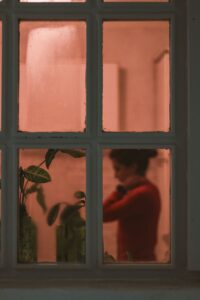
Because the result does not depend on a mirror effect, turning the interior lights on does not suddenly make the glass transparent again.
Does Frosted Privacy Window Film Work at Night?
Yes, frosted film generally provides much more dependable nighttime privacy than reflective film.
It continues to obscure direct visibility when:
- Interior lights are on
- Exterior lighting is low
- The room is brighter than outside
However, the exact level of privacy depends on the film.
Some translucent films may still reveal:
- Silhouettes
- Movement
- Shapes
- Shadows
particularly when a person or object is very close to the glass with a strong light behind them.
For highly sensitive spaces, choose a film with an appropriate privacy rating or consider a more opaque solution.
Can You See Silhouettes Through Frosted Window Film at Night?
Possibly.
This is an important expectation to set.
Frosted film is designed to obscure detail, but some products are translucent rather than fully opaque.
At night, strong interior backlighting may make blurred:
- Human shapes
- Movement
- Shadows
visible from outside.
The effect depends on:
- Frost density
- Light level
- Distance from the glass
- Film design
- Viewing distance
If silhouette privacy is critical, consider:
- Denser frost
- Whiteout film
- Blackout film
- An opaque decorative film
instead of a lighter translucent frost.
Frosted Film Still Allows Natural Light
One of the strongest reasons homeowners choose frosted film is that privacy does not require a completely dark window.
The film diffuses incoming daylight rather than simply covering the window with an opaque material.
That can keep areas such as:
- Bathrooms
- Entry halls
- Stairways
- Home offices
feeling bright while significantly reducing direct visibility.
Luxury Glass Tinting currently uses white frost window film for homes and commercial spaces where privacy and natural light need to coexist.
Frosted Film Does Not Preserve a Clear Outdoor View
There is a trade-off.
If frost prevents someone outside from clearly seeing you, it also prevents you from seeing clearly through the treated area.
That makes frost ideal for:
Bathroom window: Yes.
Front-door sidelight: Yes.
Shower glass: Yes.
Bedroom facing a close neighboring property: Often yes.
Large living-room window with a valuable city view: Possibly not.
For view-focused windows, reflective or dual-reflective film plus nighttime window coverings may be a better solution.
Reflective vs. Frosted Privacy Film at Night
| Feature | Reflective Privacy Film | Frosted Privacy Film |
|---|---|---|
| Daytime privacy | Strong | Strong |
| Nighttime privacy | Limited when inside is brighter | More consistent |
| Clear outward view | Yes | No |
| Natural light | Yes | Yes, but diffused |
| Solar heat control | Often strong | Product-dependent |
| Glare reduction | Often strong | Product-dependent |
| Privacy depends on lighting | Yes | Much less |
| Possible silhouettes | Clear visibility can return at night | Blurred silhouettes may remain |
| Best use | Street-facing/view windows | Bathrooms, entries, bedrooms |
Neither film is universally better.
They solve different problems.
Best Rooms for Frosted Privacy Window Film
Frosted film works particularly well where maintaining privacy is more important than maintaining a clear outward view.
Bathrooms
Bathrooms are one of the clearest uses for frost.
Privacy is needed:
- Morning
- Afternoon
- Evening
- Night
A reflective film that works mainly during daylight may become unreliable as soon as bathroom lights are turned on.
Frosted privacy film creates a more consistent solution while allowing natural light into the room.
Front-Door Sidelights
Clear sidelights can create a direct view into:
- Entry halls
- Living rooms
- Stairways
During daylight, that may not feel especially noticeable.
After sunset, a brightly lit interior can become extremely visible through clear entry glass.
Frosted or decorative window film can block those sightlines while preserving entrance daylight.
Bedrooms
Street-facing and ground-floor bedrooms often need privacy at exactly the time reflective film becomes weakest:
after dark with the interior lights on.
Frosted film can be a good solution when the outdoor view is less important than visual screening.
Partial frost can also be considered when homeowners want to keep the upper part of the window clear.
Street-Facing Windows
A window close to:
- A sidewalk
- Shared driveway
- Neighboring property
- Apartment walkway
may require stronger privacy.
If maintaining a clear view outside is important, reflective film may work well during the day with blinds or curtains added at night.
If continuous privacy matters more, frost may be the better choice.
Internal Glass and Partitions
Frosted film is equally useful inside the home.
Applications include:
- Glass office doors
- Interior partitions
- Bathroom glass
- Glass bedroom doors
- Study areas
Because lighting differences between two interior spaces can change constantly, a reflective privacy solution is usually less practical than an obscuring decorative treatment.
Shower Glass
Frosted decorative film can provide additional visual privacy on compatible shower or bathroom glass.
The exact product needs to be appropriate for:
- Glass type
- Moisture exposure
- Installation environment
but frost can provide a cleaner appearance than adding curtains to certain interior-glass applications.
How Frosted Film Changes the Feel of a Room
Privacy film does more than change visibility.
It can change the visual character of the space.
The Room Feels Less Exposed
The most immediate change is often psychological.
A previously clear pane no longer creates a direct sightline.
This can make:
- Bathrooms
- Bedrooms
- Entryways
- Offices
feel more private without requiring heavy window coverings.
Daylight Becomes Softer
Frosted film scatters incoming light.
Instead of sharp direct visibility, the glass can produce a more diffused appearance.
That can make a space feel:
- Softer
- Calmer
- More finished
while still benefiting from daylight.
The Glass Can Look More Intentional
Frost can mimic aspects of:
- Etched glass
- Sandblasted glass
- Architectural privacy glass
without replacing the existing pane.
WBDG notes that decorative window films can retrofit existing glass with frosted and etched-style appearances while creating private spaces that continue to welcome light.
This is one reason privacy film can function as both a practical treatment and a design element.
Decorative Privacy Film as an Alternative to Plain Frost
Not every homeowner wants solid white frost.
Decorative window film can provide privacy using:
- Patterns
- Textures
- Stripes
- Gradients
- Frosted designs
- Colored effects
This can work particularly well on:
- Entry doors
- Sidelights
- Stair windows
- Interior partitions
- Feature glass
where appearance matters almost as much as privacy.
Gradient Privacy Film
A gradient film can provide different levels of privacy across the same pane.
For example:
Clear at the top → increasingly frosted toward eye level or the bottom
This can be useful when you want:
- Privacy from pedestrians
- Daylight from upper glass
- Partial outdoor visibility
without frosting the entire window.
Partial Frost for Street-Facing Windows
Another useful design is frosting only the section of glass that creates the unwanted sightline.
For example:
Lower 60% frosted + upper 40% clear
may provide privacy from someone walking past the home while preserving:
- Sky views
- Tree views
- Additional daylight
This often creates a better result than treating privacy as an all-or-nothing decision.
What About Whiteout Film?
Whiteout film provides substantially stronger visual blocking than translucent frost.
It may be appropriate where:
- Clear visibility is unnecessary
- Maximum visual privacy matters
- A bright white appearance is acceptable
Unlike ordinary frost, whiteout is more opaque.
That can make it useful for specific areas where silhouette privacy is a concern.
What About Blackout Privacy Film?
Blackout film is used when the goal is maximum visual and light blocking.
It may work for:
- Storage areas
- Certain bedrooms
- Media spaces
- Utility rooms
- Other glass where no outside view is needed
It is not a good choice when maintaining natural daylight is a priority.
Luxury Glass Tinting’s current residential window film options include frosted/decorative privacy as well as whiteout and blackout solutions for stronger visual privacy.
Is There Truly One-Way Window Film That Works Day and Night?
Not in the way most homeowners mean when asking the question.
A conventional passive reflective film cannot provide all three of these simultaneously:
- Complete privacy from outside
- Clear visibility from inside
- Identical performance day and night regardless of lighting
The reflective effect always depends to some degree on relative brightness.
For true nighttime privacy, you generally need to sacrifice some outward visibility using:
- Frost
- Opaque film
- Whiteout
- Blackout
- Curtains
- Blinds
Another premium option for some applications is switchable privacy glass or film, but that is a different technology from standard reflective tint.
What Is Dual-Reflective Privacy Film?
Dual-reflective film has:
- Greater exterior reflectivity
- Lower interior reflectivity
This can make outward viewing more comfortable, particularly in the evening.
It is useful for homeowners who want:
- Solar heat reduction
- Daytime privacy
- Lower interior reflection
But it is important not to confuse improved nighttime viewing with guaranteed nighttime privacy.
Once the room is significantly brighter than outside, visibility into the home can still increase.
Can Curtains and Privacy Film Be Used Together?
Absolutely.
In many homes, this is one of the most practical solutions.
For example:
Reflective Film + Curtains
Reflective film provides:
- Daytime privacy
- Heat control
- Glare reduction
while curtains provide:
- Nighttime privacy
- Additional light control
Frosted Film + Shades
Frost provides:
- Constant baseline privacy
while shades can provide:
- Full light blocking
- Additional privacy
when desired.
Window film does not have to replace traditional window coverings.
The two can complement each other.
Does Privacy Window Film Reduce Heat?
It depends on the film.
Reflective privacy films are often also solar-control products and may provide substantial:
- Heat reduction
- Glare control
- UV protection
Frosted privacy film is primarily chosen for:
- Privacy
- Light diffusion
- Appearance
Its solar performance is product-specific.
Do not assume that a privacy film automatically provides strong heat rejection simply because it obscures the view.
Does Frosted Film Block UV?
Some frosted and decorative films provide substantial UV reduction.
Others are designed mainly around privacy and aesthetics.
If UV protection is important, check the technical specifications of the exact film.
Do not assume that all frost automatically provides the same UV performance as premium solar-control film.
Does Privacy Film Make Glass More Secure?
Not automatically.
Privacy and security are different functions.
Ordinary:
- Frosted film
- Reflective privacy film
- Decorative film
should not automatically be described as safety/security film.
Dedicated security window film is engineered around broken-glass retention and, in certain appropriately configured systems, forced-entry delay.
Choose privacy film for privacy.
Choose security film when security is actually the objective.
Choosing the Right Privacy Film for Your Home
Start with one question:
When do you need privacy most?
If You Need Privacy Mainly During the Day
Consider:
- Reflective privacy film
- Dual-reflective film
especially if preserving the outdoor view is important.
If You Need Privacy Day and Night
Consider:
- Frosted privacy film
- Decorative frost
- Whiteout film
- Blackout film
depending on the level of obscuration required.
If You Want Night Privacy and a Clear Outdoor View
Standard passive film cannot completely solve both requirements simultaneously.
Consider:
- Reflective film during the day
- Curtains or blinds at night
or investigate more advanced switchable privacy technologies.
If You Need Bathroom Privacy
Frosted film is generally one of the strongest options.
If You Need Entryway Privacy
Consider:
- White frost
- Decorative frost
- Partial frost
- Gradient film
depending on the design.
If You Need Street-Facing Living-Room Privacy
Decide whether preserving the view matters.
Want the view?
Reflective or dual-reflective film for daytime privacy plus nighttime window coverings.
Do not need the view?
Frosted film provides more consistent screening.
If You Need Bedroom Privacy
For windows exposed to neighbors or sidewalks after sunset, frost or another obscuring film is generally more dependable than reflective film alone.
How to Test a Privacy Film Before Installation
Do not judge privacy film only from a small sample under showroom lighting.
Ask how it behaves:
- During bright daylight
- On cloudy days
- At sunset
- After dark
- With interior lights on
For reflective film, lighting conditions are central to the privacy result.
For frost, ask how much:
- Detail
- Silhouette
- Light
remains visible.
A good privacy recommendation should set expectations for both day and night.
Privacy Film Comparison: Which One Should You Choose?
| Need | Best Starting Point |
|---|---|
| Daytime privacy + clear outward view | Reflective film |
| Daytime privacy + lower interior reflection | Dual-reflective film |
| Consistent day/night privacy + daylight | Frosted film |
| Decorative day/night privacy | Patterned or decorative frost |
| Very strong visual blocking | Whiteout film |
| Maximum privacy + light blocking | Blackout film |
| Privacy only at night while keeping clear daytime view | Reflective film + curtains/blinds |
Common Nighttime Privacy Film Myths
Myth: Every Privacy Film Works the Same at Night
False.
Reflective and frosted films create privacy in very different ways.
Myth: One-Way Film Gives Permanent One-Way Privacy
False.
The effect depends on which side of the glass is brighter.
Myth: Reflective Film Stops Working Completely After Sunset
Not necessarily.
The privacy effect depends on relative lighting, but in a typically illuminated home surrounded by nighttime darkness, privacy often becomes substantially weaker.
Myth: Frosted Film Turns Clear at Night
False.
Frost continues to obscure the view regardless of which side is brighter.
Myth: Frosted Film Guarantees Zero Silhouettes
Not necessarily.
Translucent frost may still reveal blurred shadows or movement under strong backlighting.
Myth: Frosted Film Makes a Room Dark
False.
Many frosted films diffuse natural light while obscuring the view.
Myth: Frosted Film Lets You See Clearly Outside
False.
The privacy effect works in both directions.
Myth: Reflective Film Is Better Than Frost
Neither is universally better.
Reflective film is better for daytime privacy with view retention.
Frost is better for more consistent visual screening.
Frequently Asked Questions
1. Does privacy window film really work at night?
Some privacy films do.
Reflective privacy films usually become much less effective when interior lights are brighter than the exterior.
Frosted, decorative obscuring, whiteout, and blackout films provide more consistent nighttime privacy because they do not depend on a mirror effect.
2. Does frosted privacy window film work at night?
Yes.
Frosted privacy film obscures the view through the glass, so its privacy does not depend primarily on whether the inside or outside is brighter.
Depending on the film and lighting, some blurred silhouettes may remain visible.
3. What is the difference between reflective privacy film and frosted privacy film?
Reflective privacy film relies heavily on differences in lighting and is strongest during daylight when the exterior is brighter.
Frosted film physically diffuses and obscures the view, providing more consistent privacy during both day and night.
Reflective film allows a clearer outward view; frost does not.
4. Is frosted glass window film a good option for bathrooms?
Yes.
Bathrooms are one of the strongest applications for frosted film because they need consistent privacy regardless of the time of day.
Frost can obscure visibility while still allowing diffused daylight into the room.
5. Can you still get natural light with frosted privacy window film?
Yes.
Most translucent frosted films are designed to allow daylight through while obscuring direct visibility.
The room may feel softer because the film diffuses the incoming light.
6. Does frost window film let people see shapes at night?
Possibly.
Depending on the film, distance from the window, and strength of interior lighting, blurred silhouettes or movement may still be visible.
If preventing silhouettes is essential, consider a denser frost, whiteout, blackout, or more opaque decorative film.
7. Which rooms usually need frosted privacy glass window film?
Common applications include:
- Bathrooms
- Front-door sidelights
- Ground-floor bedrooms
- Street-facing windows
- Shower glass
- Entry doors
- Stair windows
- Interior partitions
- Home-office glass
Frost is especially useful where nighttime privacy matters more than preserving a clear view.
Choose Privacy Film for the Time of Day You Actually Need Privacy
The easiest mistake to make is choosing a privacy film based only on how it looks in daylight.
A better approach is to ask:
What happens to this window after sunset?
If the room only needs screening during the day and preserving the outside view matters, reflective privacy film can be an excellent choice.
If the room needs privacy with the lights on at night, frosted or another obscuring film is usually more dependable.
If you need maximum visual blocking, consider:
- Whiteout
- Blackout
- More opaque decorative film
Luxury Glass Tinting provides professional residential window tinting in Los Angeles and decorative window film for:
- Bathrooms
- Bedrooms
- Entryways
- Door sidelights
- Street-facing windows
- Interior glass
- Home offices
The best privacy window film is not simply the darkest or most reflective product.
It is the one that provides the right level of screening at the time of day when you actually need it.
For daytime privacy with a view, start with reflective options.
For dependable nighttime screening, start with frost.